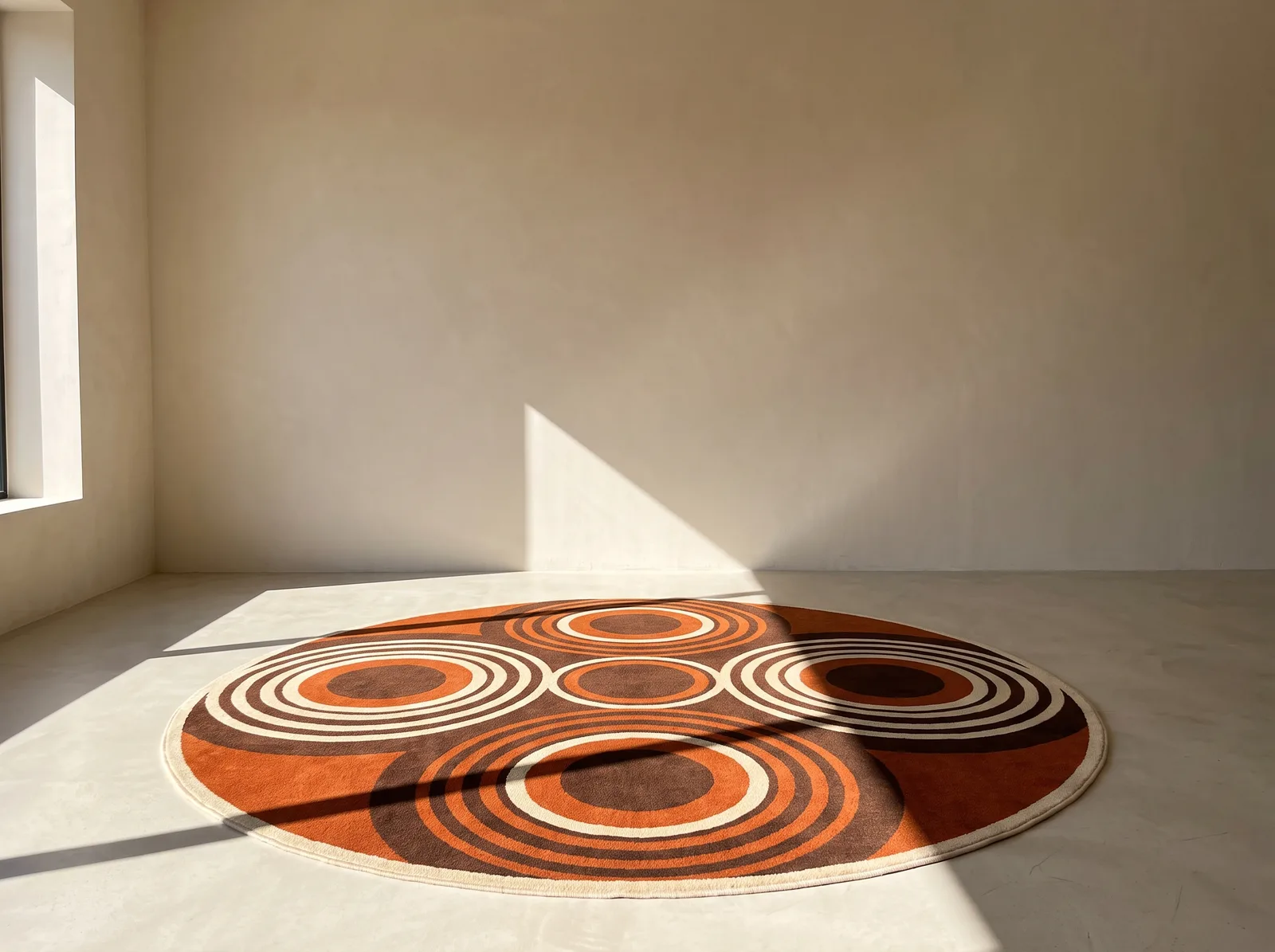
Space Age Rugs: Op Art, Colour and Retro-Futurist Rooms
Europe/USA, Op Art and space-race aesthetics
Space Age rugs translate Op Art and 1960s optimism into bold floor graphics. Explore colour, pattern and ways to balance the look.
More Than a Floor Pattern
Unlike the Persian rug or the Berber rug, the Space Age rug doesn't come from a single weaving region or a centuries-old craft tradition. Instead, it's the textile expression of a short but defining design era: the 1960s and 70s, when space travel, new materials, and a general euphoria about the future transformed the floor underfoot into a graphic surface full of circles, waves, and optical illusions.
Op Art Conquers the Floor
The visual language of the Space Age rug draws directly from the Op Art movement of the 1960s, shaped by artists like Bridget Riley and Victor Vasarely, who used precise geometric patterns to create optical illusions of movement and depth. This art movement quickly jumped from canvas to textiles, and rugs offered an ideal, large-format surface for translating the dizzying patterns into the living room. Circles, concentric waves, and sharp color contrasts moved straight from the museum wall to the living room floor.
The Space Race as a Design Driver
Alongside the Op Art movement, the space race between the US and the Soviet Union shaped the entire design sensibility of the era. The 1969 moon landing, futuristic spacecraft, and a general fascination with technology found their way into rounded, organic forms and a cool, almost otherworldly color palette. Rugs of the era picked up on this aesthetic, often featuring circular or elliptical patterns reminiscent of planetary orbits or capsule windows.
Synthetic Fibers, New Possibilities
It was only the development of new synthetic fibers like acrylic and nylon in the 1960s that made the Space Age rug's bold, saturated colors and precise graphic patterns possible at scale in the first place. These materials could be dyed in more intense tones than traditional natural wool, and also enabled industrial tufting processes that produced sharply defined patterns far faster and more affordably than classic hand-weaving.
Verner Panton and the Radical World of Color
Few designers embody the Space Age textile aesthetic as consistently as Verner Panton, who, alongside furniture like the Panton Chair, also designed radical rug and textile collections. His patterns combined bold, often unconventional color harmonies with geometric precision, influencing a whole generation of rug designers who experimented with similarly daring color and form combinations in the following decades.
Not a Single Product, But an Aesthetic
Unlike the Persian or Kilim rug, the "Space Age rug" isn't a uniformly defined product from a specific workshop tradition, but a design aesthetic tied to a particular era. Anyone searching for this look today will find it less often under the name "Space Age" and more often under related terms like "geometric rug" or "retro Op Art pattern rug." That niche character is exactly what makes it interesting for anyone looking to bring a distinct, unmistakable design era into a room, beyond the established Middle Eastern and North African traditions.
A Statement for Space Age and Pop Art
In Space Age interiors with organic seating and futuristic lighting like the Arco Floor Lamp, a rug like this fits in as a logical continuation of the room's visual language. In Pop Art rooms with bold blocks of color, it supplies the floor-level tension needed to carry the room's color drama all the way down. In both cases, this rug type demands a room willing to embrace its graphic boldness.
The Space Age Rug in Today's Interiors
Because this rug type is so visually assertive, it works best as a clear focal point in a room, surrounded by relatively restrained furniture that doesn't compete for attention. Round or oval formats further emphasize the circular patterning found in many Space Age designs. For a more subtle take, smaller formats work well as an accent under a side table rather than as a full-room statement piece.
Ateliology Style Verdict
The Space Age rug proves that a design era can leave behind a distinct, recognizable legacy even without a single, namesake workshop tradition. Born from Op Art, the space race, and new synthetic fibers, its graphic boldness remains unmistakable today. That is exactly what makes the Space Age rug a genuine style piece.
More rug styles
 Anatolia, the Caucasus, and PersiaKilim Rug
 Anatolia, TurkeyTurkish Rug
 Uşak, Western TurkeyOushak Rug
 Scandinavia, Australia, New ZealandSheepskin Rug