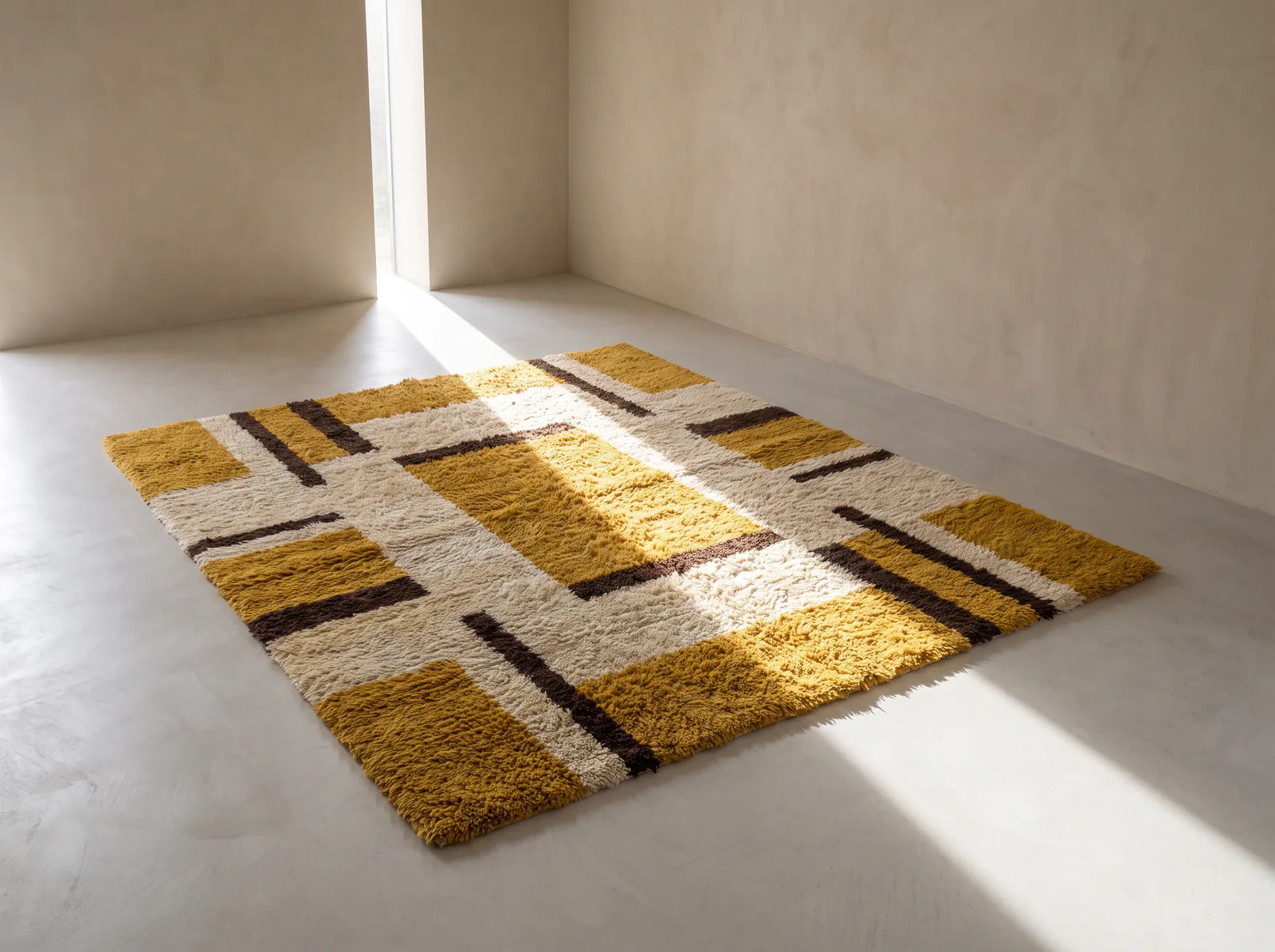
Rya Rugs: Scandinavian Pile, Pattern and Warmth
Scandinavia (Finland, Sweden)
Rya rugs combine a deep pile with Scandinavian colour and pattern. Explore their development and ways to use the texture without crowding a room.
More Than a High-Pile Rug
The Rya rug is defined by its long, dense pile and often bold, graphic patterning, clearly setting it apart from the more muted natural-fiber rugs of other Scandinavian traditions. Its dual nature — practical craft on one hand, artistic expression on the other — makes it one of the most interesting chapters in Nordic textile history.
From Boat Cover to Textile Art Form
The origin of the Rya rug dates back to the Scandinavian Middle Ages, where coarse, knotted wool textiles served as weatherproof covers on fishing boats and as warm bedding during cold Nordic winters. The long, dense pile served a purely practical function: keeping out cold and moisture, long before it became a design feature.
The Finnish Knot as a Technical Foundation
Constructively, the Rya rug is based on a special knot that binds wool tufts into a coarse-mesh base structure, producing a noticeably longer, denser pile than classic Oriental rugs. This technique allowed the finished rug to serve as a floor covering, a bedcover, or a wall hanging — a versatility highly valued in sparse Nordic households.
From Craft to Modernist Canvas
In the 20th century, Finnish and Swedish textile artists like Uhra-Beata Simberg-Ehrström rediscovered the Rya rug as a medium for abstract, often boldly graphic compositions. At the 1951 Milan Triennale, Finnish Rya rugs caused an international sensation and played a significant role in establishing Scandinavian design as a distinct, globally recognized movement.
A Symbol of Mid-Century Modern
In the 1950s and 60s, the Rya rug became a fixture of Scandinavian Mid-Century interiors, often featuring abstract patterns reminiscent of modern painting in mustard yellow, ochre brown, and cream white. Vintage pieces from this golden age are now traded as collector's items and considered one of the most striking textile legacies of Nordic design history.
A Statement for Vintage, Mid-Century, and Boho
The Rya rug naturally fits into Vintage interiors, evoking Scandinavian design's golden age, as well as into Mid-Century rooms with warm wood and geometric textures, and into Boho interiors, where its high pile adds extra coziness.
The Rya Rug in Today's Interiors
Hung as a wall piece, the Rya rug can showcase its graphic patterning like a textile artwork, without being exposed to the wear of a floor covering. As a floor rug beneath a sofa, its high pile provides an especially soft, inviting feel underfoot.
Ateliology Style Verdict
The Rya rug proves that a practical boat-cover craft can become a distinct artistic expression. From Finnish fishing boats to the Milan Triennale, it remains emblematic of Scandinavian design innovation. That is exactly what makes the Rya rug a genuine style piece.
More rug styles
 Turkey (source carpets), global trendOverdyed Rug
 USA/Western Europe, with roots in Greece and ScandinaviaShag Rug
 Atlas Mountains, Morocco (Amazigh/Berber tribes)Moroccan Berber Rug
 Diné (Navajo) Nation, American SouthwestNavajo Rug