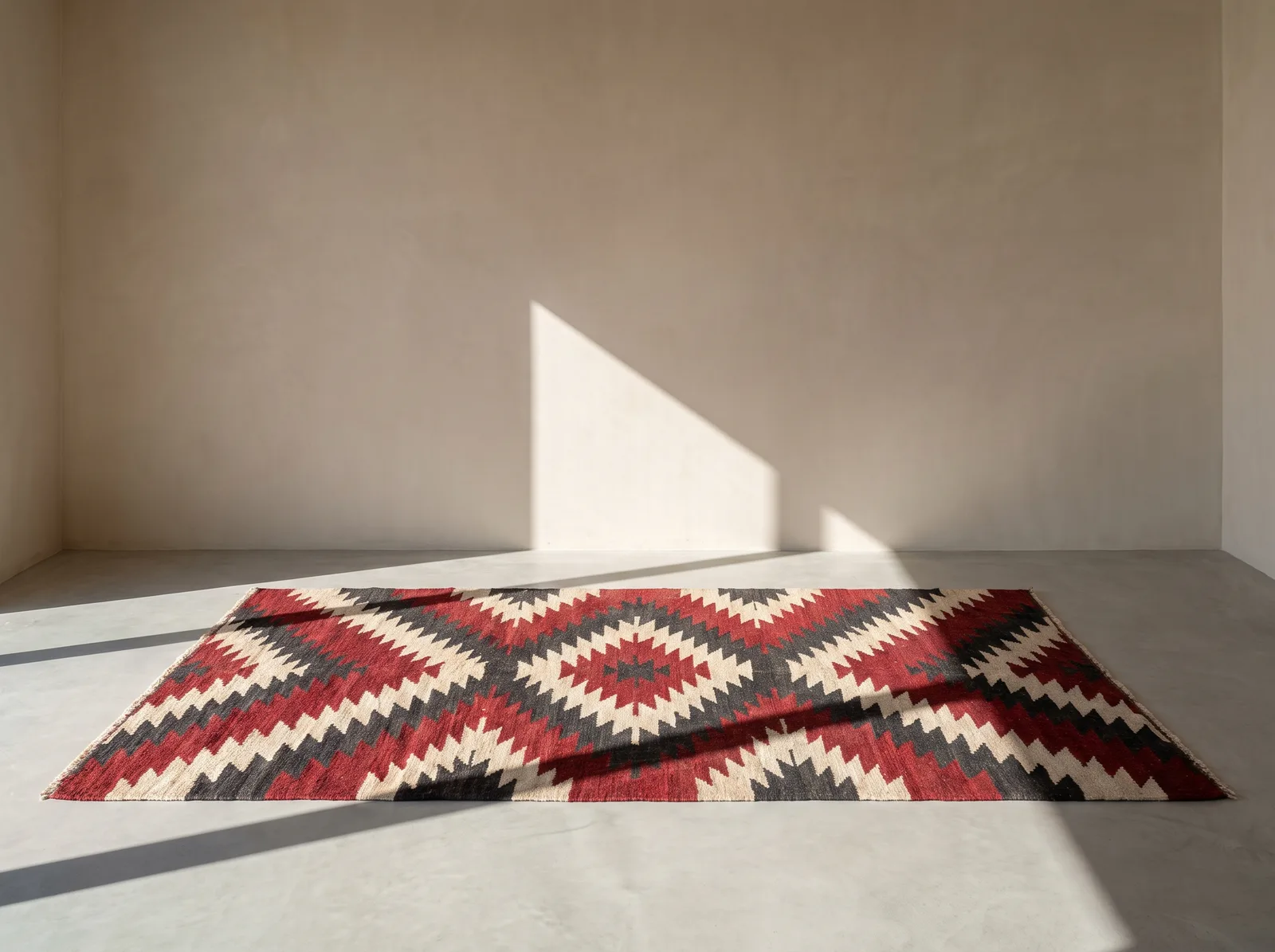
Navajo Rugs: Geometry, Weaving and Cultural Context
Diné (Navajo) Nation, American Southwest
Navajo rugs are woven textiles with distinctive geometry and a specific cultural history. Explore their technique, context and careful placement.
More Than a Textile
Bold zigzag lines, lightning patterns, and geometric diamonds in deep red, black, and natural white — the Navajo rug is one of the few textile art forms inseparably tied to a specific nation and landscape: the Diné Nation of the American Southwest. Unlike many other rug traditions, Navajo weaving didn't develop in isolation, but as the result of cultural exchange, technical adaptation, and economic necessity spanning several centuries.
Learned From the Pueblo Peoples
According to tradition, the Diné (Navajo) learned the art of weaving in the 17th century from their neighbors, the Pueblo peoples, who had already been weaving cotton for centuries. The Navajo adapted this technique to wool after Spanish settlers brought Churro sheep to the region, whose sturdy, long-fibered wool proved excellent for weaving. Within a few generations, the Diné developed a weaving tradition distinctly their own, clearly diverging from its Pueblo origins.
From Wearing Blanket to Trade Good: the Chief Blankets
The earliest significant Navajo textiles weren't floor rugs at all, but so-called "chief blankets" — finely woven wearing blankets originally made for personal use and as valuable trade goods with neighboring tribes. Their simple, horizontal stripe patterns were considered a status symbol and traded far beyond Navajo territory. It was only later, as demand grew from settlers and travelers, that production increasingly shifted from wearable blankets toward the floor-rug format known today.
The Trading Post Era
Starting around 1880, trading posts across Navajo territory fundamentally changed production: traders like J. B. Moore at the Crystal Trading Post began deliberately introducing pattern books and color specifications to better match the tastes of Anglo-American buyers back east. This gave rise to regional styles with their own names, such as Two Grey Hills with its natural gray-black-white palette, Ganado Red with bold red and a central cross motif, or Teec Nos Pos with its especially complex, densely woven patterning. This trading-post era made the Navajo rug one of the first Indigenous crafts in the US with a genuine nationwide commercial market.
Craft in Wool and Natural Dyes
Traditional Navajo rugs are made on simple vertical looms using a flatweave technique, with no knots at all — a technical difference from Persian or Berber rugs. The wool typically comes from the namesake Churro sheep and is traditionally dyed using natural pigments from plants, minerals, and insects, while natural gray, black, and white tones are often left undyed. Weaving a mid-sized rug can take several months depending on complexity, with the entire pattern developing in the weaver's mind as she works, with no pre-drawn template.
A Protected Designation
Because of the high demand for and cultural value of genuine Navajo rugs, the Diné Nation today legally protects the designation "Navajo" against misleading marketing of non-authentic reproductions, similar to protected designations of origin for European products. Genuine, hand-woven Navajo rugs are often sold with a certificate of authenticity and are priced accordingly high given the enormous time investment involved — a fact that further underscores their status as a treasured collector's item rather than a purely decorative object.
A Statement for Eclectic, Vintage, and Traditional
A Navajo rug brings instantly recognizable, bold geometry into a room, which is why it works especially well in eclectic interiors, standing as a striking single accent alongside calmer furniture. In Vintage rooms with walnut furniture and warm earth tones, it fits coherently into an overall Americana-inflected aesthetic. And in traditionally styled interiors, it honors a textile tradition of real cultural depth as an authentic piece of craft.
The Navajo Rug in Today's Interiors
Smaller Navajo rugs work beautifully as wall hangings, a use that gives the textile a museum-like presence without exposing it to floor wear. Larger pieces work well as a focal point in front of a fireplace or beneath a side table, where the bold patterning doesn't have to compete with other rugs or strong patterns. When buying, it's always worth asking about origin and authenticity to distinguish hand-woven originals from machine-made reproductions.
Ateliology Style Verdict
The Navajo rug shows how a craft learned from neighbors could become, within a few centuries, a distinct and globally recognized art form. Its bold geometry, shaped by trade history and cultural adaptation, remains unmistakable today. That exact combination of craft depth and visual clarity is what makes the Navajo rug a genuine style piece.
More rug styles
 Anatolia, the Caucasus, and PersiaKilim Rug
 Anatolia, TurkeyTurkish Rug
 Uşak, Western TurkeyOushak Rug
 Scandinavia, Australia, New ZealandSheepskin Rug