Back to overview
LC4 Chaise Longue
1928 (early Modernism)

LC4 Chaise Longue

Le Corbusier, Charlotte Perriand, Pierre JeanneretCassina, Italy (licensed production)

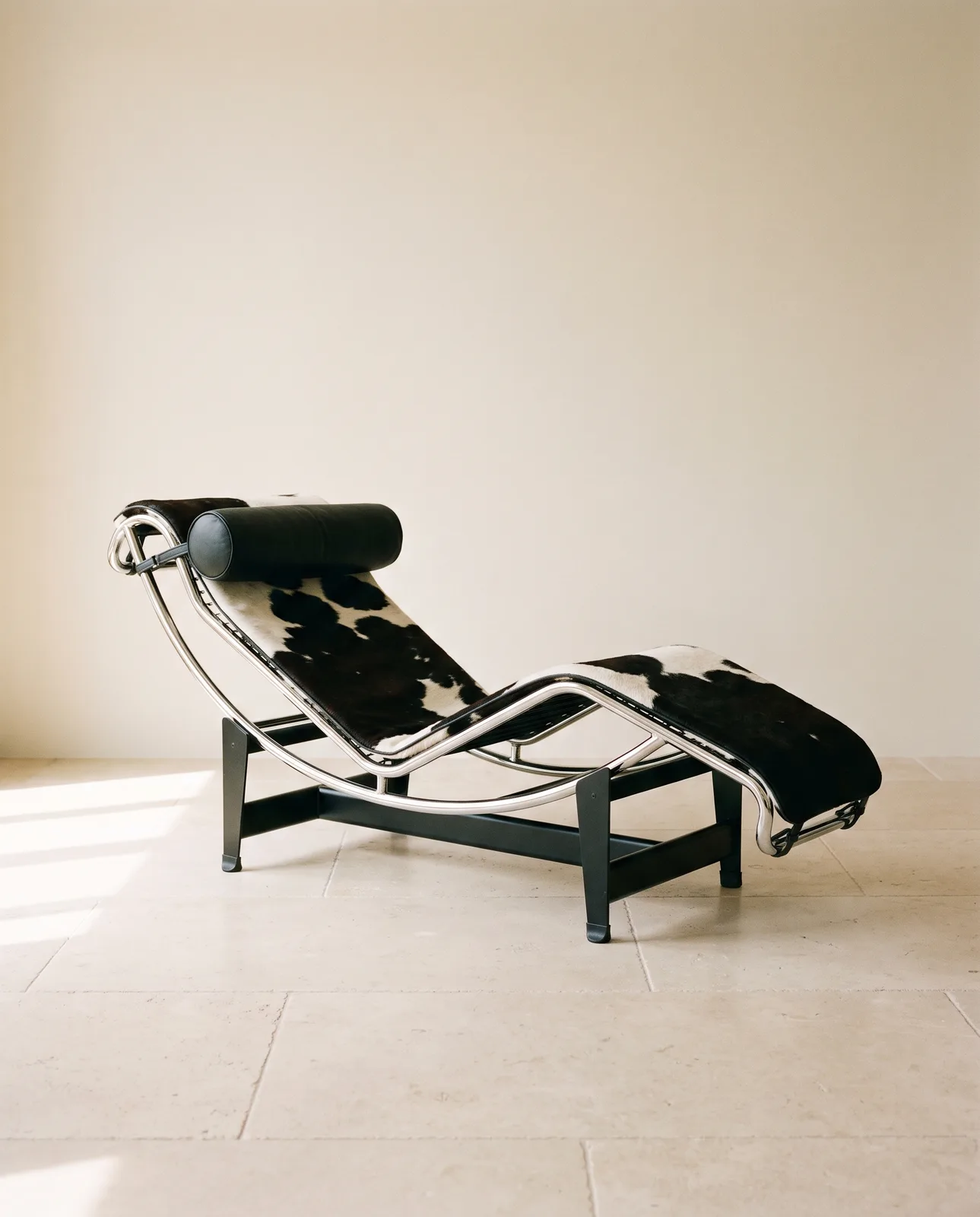
A chrome tubular-steel shell on a black base, upholstered in black-and-white cowhide: the LC4 was never meant to be a mere daybed — Le Corbusier, Charlotte Perriand, and Pierre Jeanneret called it a "relaxation machine" when they designed it in 1928, and it remains one of Modernism's most recognizable pieces.

A "relaxation machine" for 1929

The LC4 was developed in 1928 in Le Corbusier's Paris studio and first shown publicly in 1929 at the Salon d'Automne, alongside the other seating pieces in the series under the title "Equipement de l'habitation." Unlike many design classics, authorship here is clearly shared: Charlotte Perriand, who joined the team in 1927, is credited with much of the technical engineering, while Le Corbusier and his cousin Pierre Jeanneret contributed the overall architectural concept. Le Corbusier himself didn't describe the piece as a lounger but as a "machine à repos" — a machine for rest, built to place the body in an ergonomically considered position rather than simply laying it down.

The construction: a shell that slides on its base

The LC4's principle is refreshingly simple: a curved shell of chromed tubular steel, padded and upholstered in hide or leather, rests loosely on a stationary, usually black-lacquered H-shaped steel base. Before sitting down, the shell can be slid along that base and set at virtually any angle between upright and fully reclined — a friction-based adjustment system with no mechanism, lever, or screw involved. Once someone sits down, their own body weight keeps the shell from sliding further. That construction was strikingly unusual for 1928, solving adjustability through a physical principle rather than complicated mechanics.

A statement for machine-age Modernism

Stylistically, the LC4 exemplifies early-1920s Modernism, which broke furniture-making away from handcrafted ornament and brought industrial materials — tubular steel, glass, chrome — into the living room, the same movement that produced the Bauhaus. Le Corbusier saw in the gleaming, mass-producible steel tube a symbol of a new, rational way of living; the rustic cowhide upholstery forms a deliberate counterpoint of nature against machine. It's exactly that tension between cool technology and warm, organic material that keeps the LC4 unmistakable today.

Why black-and-white cowhide sharpens the form

The LC4 is offered in numerous materials, from solid leather to wool fabric, but the black-and-white spotted cowhide version remains the best known. The hide's irregular pattern functions like a second contour line, sharpening the shell's curved silhouette without distracting from it — unlike a patterned textile, hide never reads as decorative in the classic sense; it stays raw and materially honest. In an otherwise pared-back, light room, this version reads as a graphic, almost sculptural accent, while solid black leather makes the piece feel more restrained and monolithic.

The LC4 in a style mix

Because the LC4 already bridges industry and natural material on its own, it gets along with a surprisingly wide range of neighbors. Next to Brutalism's raw poured concrete, it forms a coherent family of related material languages; in a Modern Organic room with limewash plaster and natural stone, the cowhide supplies exactly the organic note the room needs. It also works surprisingly well next to historicist furniture like a Chippendale chest or a Louis XVI console table — the sharp material contrast between carved wood and polished steel makes both pieces more interesting rather than canceling each other out.

Ateliology Style Verdict

The LC4 shows how a piece of furniture that thought of itself as a machine can, nearly a century later, become emblematic of design perfection. Its friction-based adjustability, the interplay of steel and hide, and its clear stance against ornament make it one of furniture history's most uncompromising statement pieces.