Barcelona Chair
Ludwig Mies van der Rohe & Lilly Reich — Knoll, USA
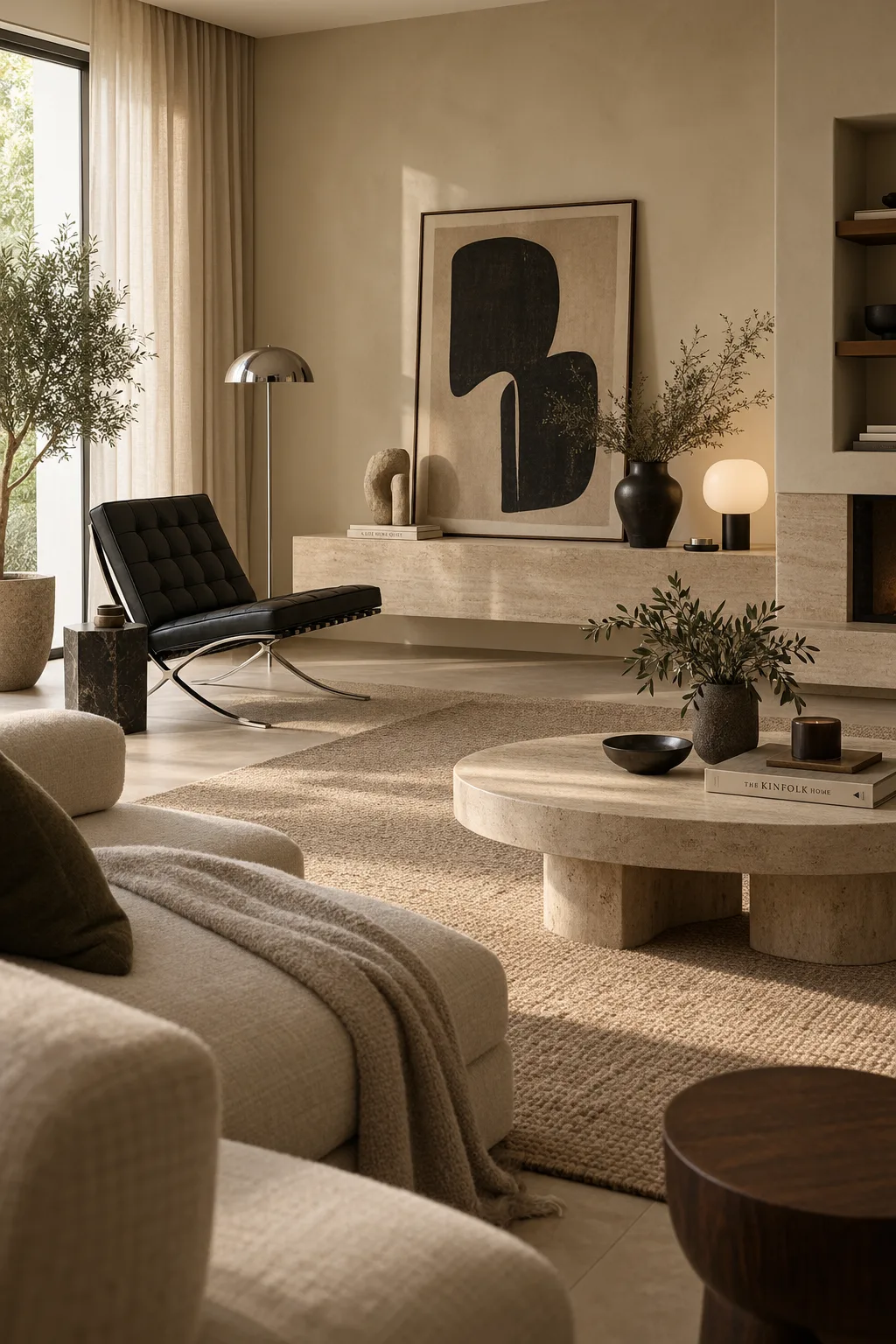
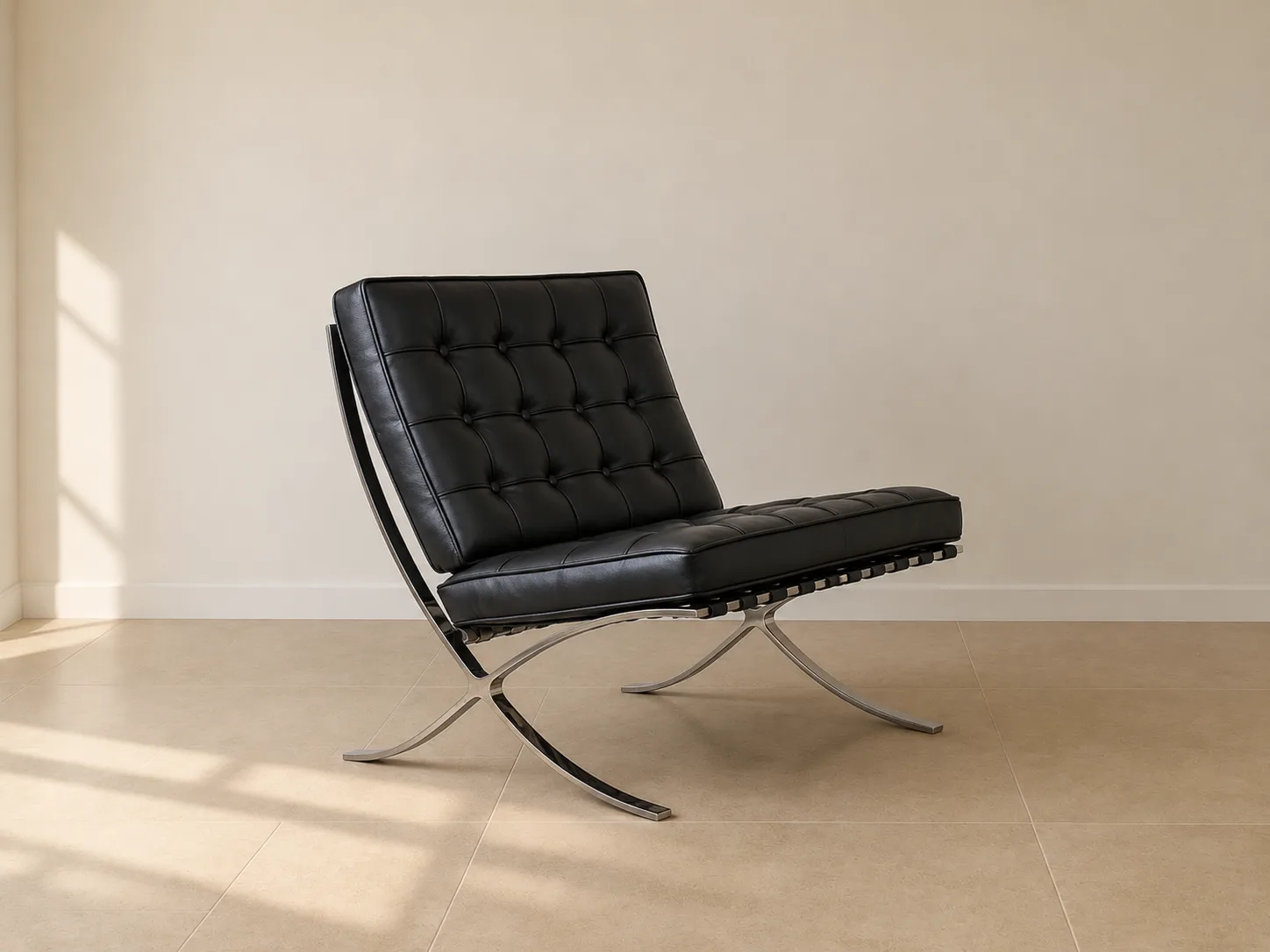
A flat, almost floating seat cushion, a striking X-shaped steel frame, and characteristic tufted leather: few pieces of furniture embody the idea that reduction can look more luxurious than ornament as clearly as the Barcelona Chair.
The origin: a chair for modernism
The Barcelona Chair was designed in 1929 by Ludwig Mies van der Rohe and Lilly Reich for the German Pavilion at the World's Fair in Barcelona. That context alone explains why the chair holds such an extraordinary position. The German Pavilion was no ordinary exhibition building but a manifesto of modernism: it was meant to represent a new, cosmopolitan, cultivated Germany — not through decorative abundance, but through space, material, and proportion. Mies van der Rohe built on an architecture of clarity, openness, and calm, reduced to the essential and executed with the utmost precision. A building like that needed furniture that matched its stance. The Barcelona Chair was therefore never conceived as an incidental seat, but as a representative piece carrying the pavilion's language forward. It's often mentioned that it was originally intended for the reception of the King and Queen of Spain — whether one takes that as symbolic background or literal use, the Barcelona Chair was designed from the start as a dignified, almost ceremonial object.
Formal rigor with a classical air
What makes the Barcelona Chair so special is the apparent contradiction in its design. At first glance it looks radically modern: clean lines, exposed steel, no superfluous ornament. And yet it carries something almost classical. Its X-shaped base distantly recalls historical folding or curule stools known from antiquity and courtly contexts — but that historical echo is translated entirely into the language of the 20th century. Nothing about it feels nostalgic: the lines are smoothed, abstracted, and reduced to an almost mathematical elegance. That's exactly where much of the chair's strength lies — it is modern without being cold, and luxurious without becoming decorative. The seat and back cushions are generous but never bulky, the frame is present but never heavy. The chair's clear horizontal orientation makes it feel calm and grounded, while the curved steel profiles give it a subtle dynamism at the same time.
Bauhaus, the International Style, and modern luxury
The Barcelona Chair is closely tied to the ideas of the Bauhaus and the International Style, even though it can't be reduced to a simple formula. The modernism of that era wanted to rationalize design, leave ornamental excess behind, and arrive at a universal, clear visual language. But the Barcelona Chair isn't simply functional in a dry sense — it's also luxurious. That shows especially in its choice of materials: leather and polished steel were — and still are — anything but modest materials. The chair demonstrates that modernism doesn't have to look ascetic or poor. Instead, it displays a form of luxury built on precision, material honesty, and perfection of proportion. While many classic luxury pieces convey status through carving, gilding, or heavy fabric, the Barcelona Chair achieves the same effect through restraint — and it's exactly that kind of controlled nobility that keeps it so coveted today.
Why black leather works so well
The Barcelona Chair in black leather is probably its best-known form — and for good reason. Black intensifies its architectural clarity: the tufted upholstery panels read more graphically, almost like a grid. At the same time, the dark leather forms a strong contrast against the chromed or polished steel frame, creating a play between softness and hardness, surface and line, upholstery and construction. Black leather also gives the chair an almost universal versatility: in bright, minimalist rooms it becomes a precise statement, while in darker, more luxurious interiors it fits in almost naturally. Paired with stone, travertine, glass, or concrete it looks especially strong, since those materials reinforce its modernist DNA. At the same time, it can work in warmer rooms too — next to wood, wool, or vintage pieces — creating an engaging contrast between the chair's strict modernism and the softer atmosphere of the rest of the room.
The significance of the button tufting
One essential detail of the Barcelona Chair is the characteristic square button tufting on its leather cushions. It's not mere decoration — it defines the chair's entire identity. Without that grid structure, the chair would look noticeably plainer, perhaps even more clinical. With it, the chair gains depth, rhythm, and a touch of luxury. The tufting structures the surface without creating ornamental excess — a decorative detail that is nonetheless fully embedded in the overall logic of the design. That's exactly what characterizes great design classics: even the details don't just serve appearance, they reinforce the underlying design idea. On the Barcelona Chair, the grid of buttons creates tension between soft upholstery and precise order, which is why the chair reads as comfortable but never shapeless.
Why the Barcelona Chair is a genuine style piece
Not every famous piece of furniture defines a room instantly — the Barcelona Chair does. Its formal identity is so strong that it can hold its own even alone in an almost empty room. It doesn't need an elaborate staging around it: its proportions, material combination, and iconic frame alone are enough to give a space character. That's exactly what makes it a genuine style piece — it works as an eye-catcher, carries design history, instantly lends a room an architectural level, and feels high-quality without being loud. Above all, it stands for a particular kind of taste: choosing a Barcelona Chair isn't a choice for mere comfort or decoration, but for a piece of furniture with a cultural and design-driven statement.
The Barcelona Chair in today's interiors
What makes the Barcelona Chair especially compelling today is how well it integrates into very different stylistic worlds. Its most obvious home is naturally a modernist or minimalist room, where it can unfold its full clarity — it works especially well with travertine or limestone, exposed concrete or smooth plaster walls, glass and chrome, neutral beige, white, grey, or black tones, and sculptural lighting paired with just a few carefully chosen objects. But the Barcelona Chair can also be very convincing in style fusions: in a room with vintage wood furniture it adds tension, in a warmer Modern Organic concept it sets a cooler architectural accent, and even in eclectic interiors it can serve as a calm counterweight. Because its form is so reduced, it clashes less with other styles than many more decorative classics — it demands space, but not stylistic submission.
Less lounge chair, more architectural object
Although the Barcelona Chair is of course meant for sitting, it functions almost more as an object than as an ordinary armchair. That's because its design grew out of an architectural way of thinking — you can tell it didn't become beautiful by accident, but grew out of clear design discipline. It is therefore not a "cozy chair" in the classic sense: its effect rests less on homely comfort than on cultivated openness. It doesn't primarily invite curling up, but rather deliberate sitting, observing, and lingering. That's exactly what makes it so iconic — it embodies a modern idea of living, in which rooms aren't filled with abundance but defined by a few precise pieces.
An icon that has never really aged
Nearly a century after it was created, the Barcelona Chair still feels remarkably current. Many pieces of furniture from the 1920s and '30s wear their era visibly — the Barcelona Chair does too, but in a way that reads as timeless rather than dated. Its strength lies in resting on fundamental principles: proportion, material contrast, clarity, and reduction. Principles like that barely age. That's why the Barcelona Chair is still relevant today — not just as a design classic, but as a living piece of furniture that continues to hold enormous presence in contemporary rooms.
Ateliology Style Verdict
The Barcelona Chair is one of the strongest statement pieces there is when you want to charge a room with elegance, modernism, and architecture. Especially in black leather, it feels commanding, iconic, and extremely timeless. It needs no elaborate surroundings — on the contrary: the more room it's given to breathe, the stronger its form comes through. That exact mix of modernism, luxury, and calm is what makes it a genuine style piece of the 20th century.