Back to overview
Egg Chair
1958 (Mid-Century Modern / early Space Age)

Egg Chair

Arne JacobsenFritz Hansen, Denmark

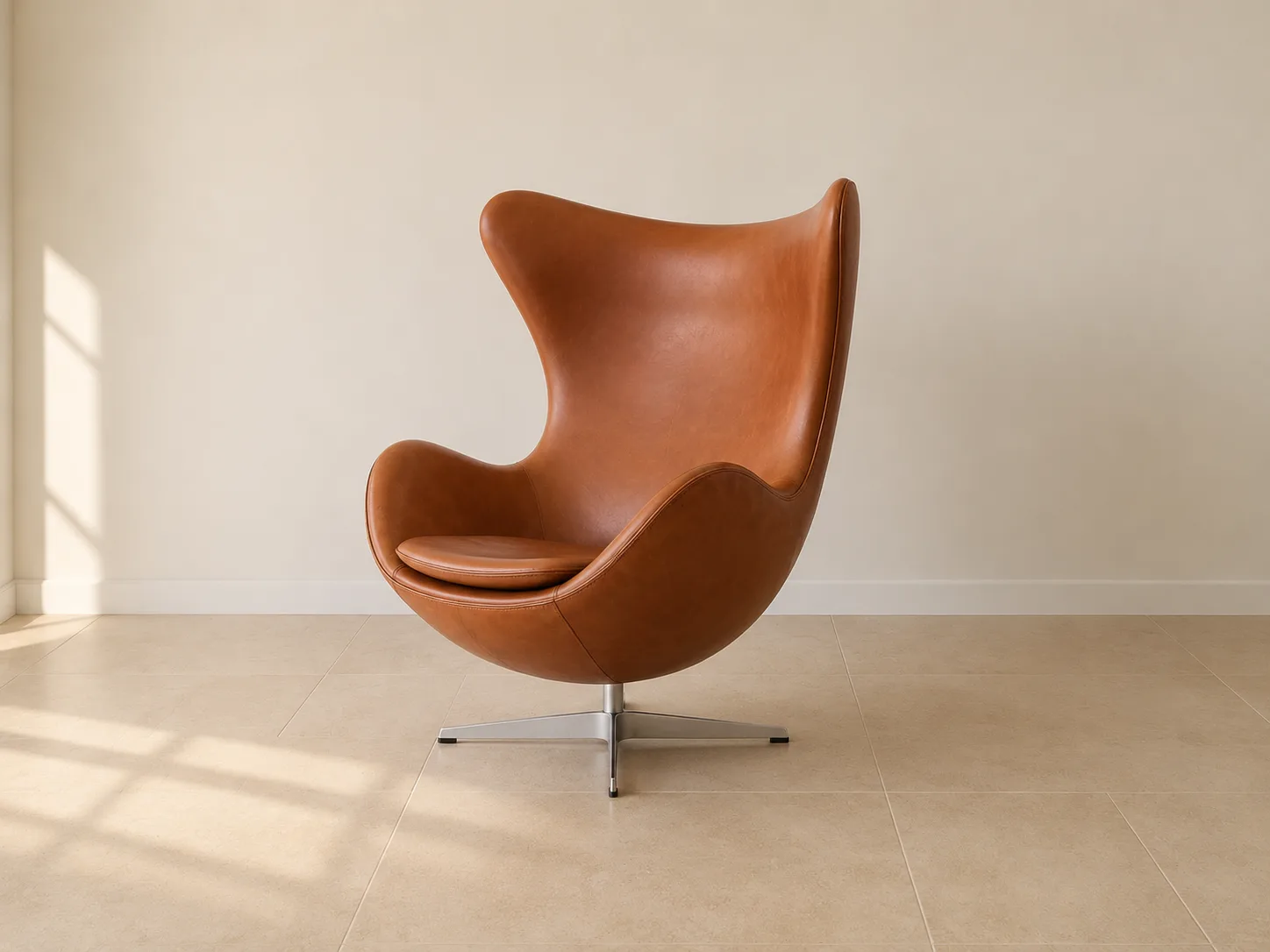
A tall, sweeping backrest, wing-like sides, and an almost sculptural form: few pieces of furniture have a silhouette as instantly recognizable as Arne Jacobsen's Egg Chair — a symbol of post-war Scandinavian modernism.

A chair for one of Europe's most modern hotels

The Egg Chair was designed in 1958 by the Danish architect and designer Arne Jacobsen for the SAS Royal Hotel in Copenhagen, known today as the Radisson Collection Royal Hotel. The building was extraordinary for its time: Jacobsen designed not just the architecture but practically the entire interior — from furniture to lighting to door handles and cutlery — creating a kind of modern total work of art. The Egg Chair played a particular role within that concept. The hotel lobby was large, open, and shaped by the clean lines of international modernism, and Jacobsen wanted to create pockets within that open space that gave guests a sense of calm and privacy. The chair's tall backrest and curved sides created a kind of small personal architecture — whoever sat down in it was partly shielded from their surroundings. That idea still holds today: high-back chairs are used in modern hotel lobbies, offices, and open living spaces for exactly the same reason, to carve out small retreats within larger rooms.

Revolutionary manufacturing

The Egg Chair's unusual form would have been difficult to achieve with traditional furniture-making techniques, so Jacobsen experimented with new materials and manufacturing methods. The chair is built around a molded shell, which is then upholstered in fabric or leather — a strikingly modern approach for the 1950s. Instead of assembling a classic chair from a wood frame, springs, and padding, Jacobsen could shape the entire seating body as one nearly continuous three-dimensional form. That's how the characteristic silhouette came about: seen from the front, the shape does resemble an opened egg, while also echoing a classic wingback chair — radically abstracted. That's a key part of the Egg Chair's design quality: Jacobsen didn't reinvent the wingback chair from scratch, he translated it into the visual language of modernism.

Scandinavian Modern meets Space Age

Stylistically, the Egg Chair belongs first to Scandinavian Modern or Mid-Century Modern design. But the chair also carries qualities that already point toward the Space Age design of the 1960s and '70s. While much Scandinavian furniture of the era worked with visible wood, clean lines, and relatively light construction, the Egg Chair reads almost as a monolithic object: its form is soft, closed, and three-dimensional, setting it clearly apart from many of its contemporaries. Its organic silhouette echoes the developments of so-called Organic Modernism, in which designers began replacing geometric shapes with lines drawn more from nature. The result feels remarkably timeless — an Egg Chair can work equally well in a classic Mid-Century room, a Space Age interior, a minimalist apartment, or even a more traditional space.

Why cognac-colored leather works so well

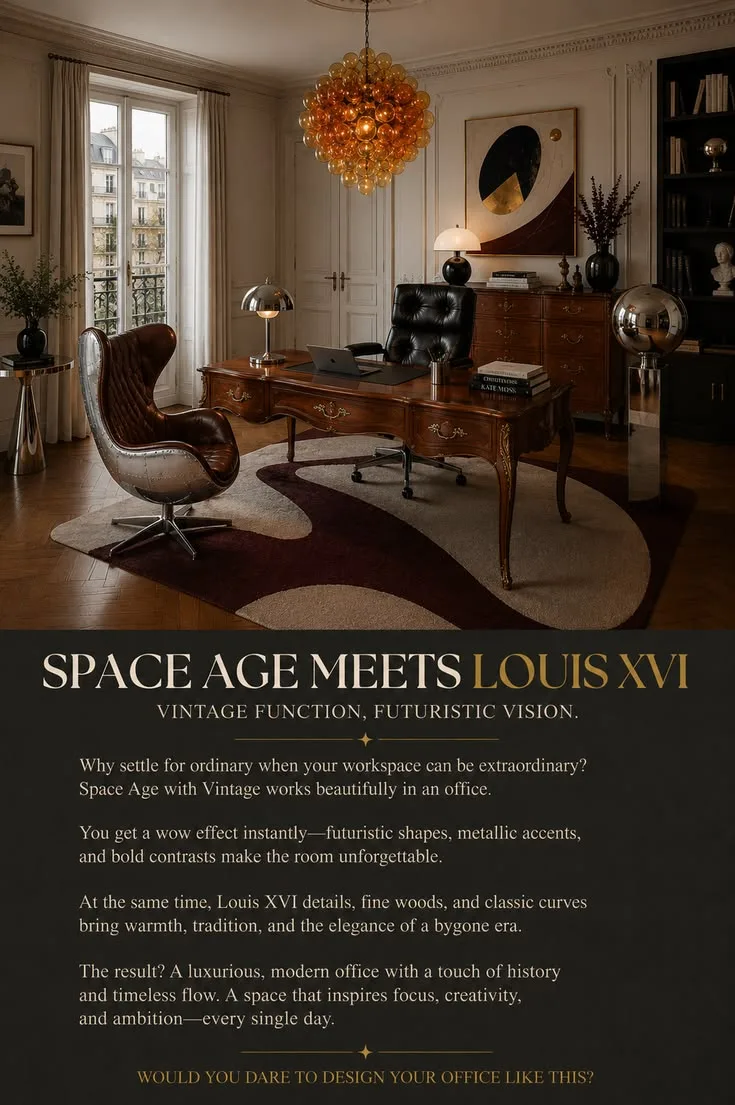
One of the strongest versions of the Egg Chair is the warm cognac leather execution — the material changes the design's effect considerably. In bold fabric colors, the Egg Chair can read very much as 1960s futurism; in black leather it feels elegant and almost institutional. Cognac leather adds another layer: the warm brown recalls classic club chairs, fine leather goods, and traditional craftsmanship, while the chair's form stays unmistakably modernist. That produces an interesting contrast — traditional material paired with futuristic form — and it's exactly this tension that makes the chair so versatile. Next to walnut, dark wood, or vintage furniture it looks surprisingly harmonious; in a minimalist room, it can instead serve as a warm counterweight to stone, concrete, or pale walls. As leather ages it also develops patina, which takes the chair a step away from the perfection of a design object and gives it character.

The power of the silhouette

A true design icon can often be recognized by its outline alone, and the Egg Chair carries that quality to an extreme. Its tall backrest rises steeply before opening into two wing-like sides, narrows below that, and then flares forward again around the armrests. There is practically no fully straight line in it — and yet the chair never feels arbitrary, because the whole form follows a very precise balance of volume, curve, and proportion. The comparatively slender metal base adds to that effect: the large upholstered body almost seems to float above the floor. On four solid legs, the same chair would feel considerably heavier — the central swivel base underlines its futuristic character instead.

Why the Egg Chair is a genuine style piece

Not every famous piece of furniture automatically works as the focal point of a room — the Egg Chair does. Its scale and silhouette draw attention without needing any further decoration; in an otherwise nearly empty room, a single Egg Chair can already make a complete design statement. That's exactly why it works so well as a style piece: instead of filling a room with many smaller design objects, one strongly characterized piece can define the entire atmosphere. The Egg Chair instantly evokes certain associations — 1950s modernism, Scandinavian design, architecture, design history, and a hint of Space Age — giving it a design depth that purely decorative furniture usually lacks.

The Egg Chair in a modern interior

What makes the chair especially interesting today is how it performs in style fusions. In a purely Mid-Century interior it's historically fitting but somewhat predictable — it gets more compelling when combined with other stylistic worlds. A cognac Egg Chair pairs beautifully with warm minimalism and limewash walls, with Brutalism's concrete and solid stone, with vintage walnut and dark wood furniture, with Space Age chrome or glass lighting, with Modern Organic interiors built on natural stone and warm textiles, or even with classical, ornamental furniture pieces. That last combination can be especially compelling: next to a historical sideboard or an antique chest of drawers, a deliberate contrast forms between classical furniture-making and modernist form language. That turns the Egg Chair from simply being part of one interior style into a connecting element between different design periods.

A design icon that has barely aged

More than six decades after its introduction, the Egg Chair still feels remarkably current. That's likely because Arne Jacobsen wasn't designing a short-lived trend — the form is built on fundamental principles instead: shelter, ergonomics, proportion, and spatial presence. The chair therefore looks historical and futuristic at once: you can place its origins in the 1950s, yet its silhouette would fit just as naturally into a contemporary interior. That's exactly the quality that defines great design classics — they represent their era without being fully bound to it. The Egg Chair, then, is not simply a famous chair. It's a piece of architecture within a room, and one of the strongest examples of how a single piece of furniture can define an interior's identity.

Ateliology Style Verdict

The Egg Chair works best when given room to breathe. Rather than surrounding it with more statement pieces, let its sculptural silhouette do the work. Especially in cognac leather, it bridges classic warmth, Mid-Century Modern, and Space Age futurism all at once — and that versatility is exactly what makes it one of the most timeless style pieces of the 20th century.