Back to overview
Nuage Bookshelf
1952–1956 (Modernism)

Nuage Bookshelf

Charlotte PerriandCassina, Italy (licensed production)

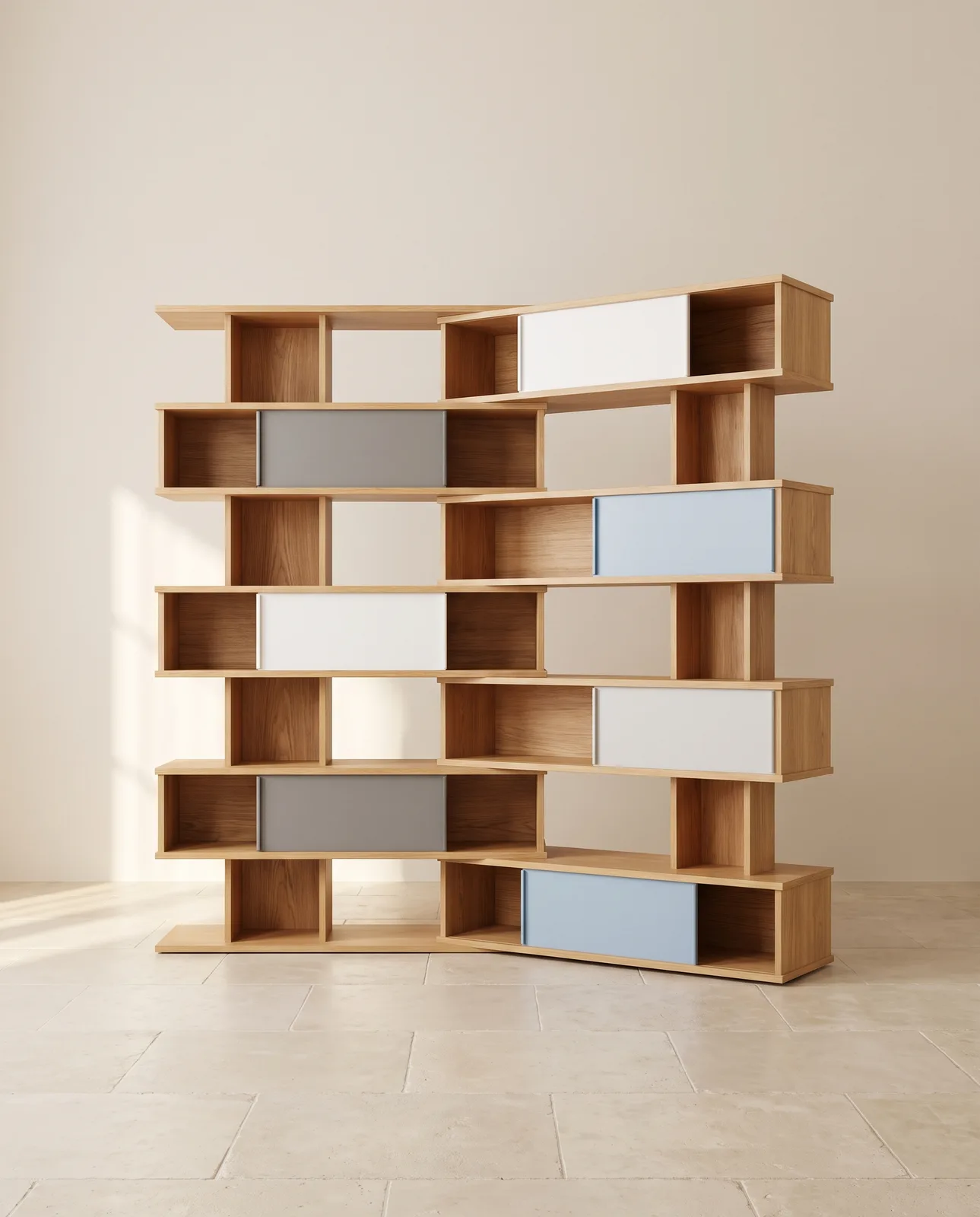
A shelving unit that reads not as a rigid block but as a floating, irregular cloud of wood compartments: Charlotte Perriand's Nuage system was created in the 1950s for her own apartment — proof that storage can be conceived sculpturally.

Designed for her own four walls

Charlotte Perriand, who had previously worked closely with Le Corbusier and Pierre Jeanneret, developed the Nuage shelf ("nuage" is French for cloud) between 1952 and 1956, initially for her own Paris apartment. After her years as a furniture designer within Le Corbusier's team, Perriand increasingly worked independently, favoring a more organic, less strictly geometric form language — a shift also shaped by her time in Japan, where she served as a design consultant during the 1940s.

A modular system without fixed symmetry

The shelf consists of a modular system of open and closed wood compartments in different sizes that can be staggered and arranged asymmetrically rather than sitting in a rigid, symmetrical grid. That modularity let the shelf be adapted exactly to different wall widths, ceiling heights, and storage needs — an advanced concept of individual configurability for the 1950s that wouldn't become a furniture-design standard until decades later.

Japanese influence on European Modernism

The staggered, asymmetrical arrangement of the Nuage system can also be read stylistically as an influence of Japanese design principles, which Perriand engaged with intensively during her time in Japan — such as the principle of deliberately uneven yet still balanced compositions found in traditional Japanese architecture and spatial partitioning. That fusion of European functionalism and Japanese asymmetry makes Perriand's later work stylistically distinct from her earlier, more strictly geometric work with Le Corbusier.

Storage as wall sculpture

Because the individual compartments are mounted not flush but staggered at different depths and heights, the shelf casts shifting shadows depending on the light, reading less like a purely functional storage piece and more like a three-dimensional wall composition. That sculptural character makes the Nuage shelf a rare example of functional storage becoming a room's aesthetic centerpiece, rather than staying discreetly in the background.

The Nuage shelf in a style mix

The shelf works especially well in rooms that already favor calm, natural materials: in a Japandi living room, it underlines the balance of reduction and natural material the style already seeks; in a Modern Organic room with limewash plaster and natural stone, it supplies a warm wood texture; and next to Vintage furniture from different eras, it serves as a flexible, unobtrusive stage for books, art objects, and personal collections.

Ateliology Style Verdict

The Nuage shelf proves that storage never has to be thought of as merely functional. Charlotte Perriand's combination of modular flexibility and deliberate asymmetry makes it one of furniture Modernism's most sculptural style pieces — a shelf that's already a work of art even before a single book goes on it.