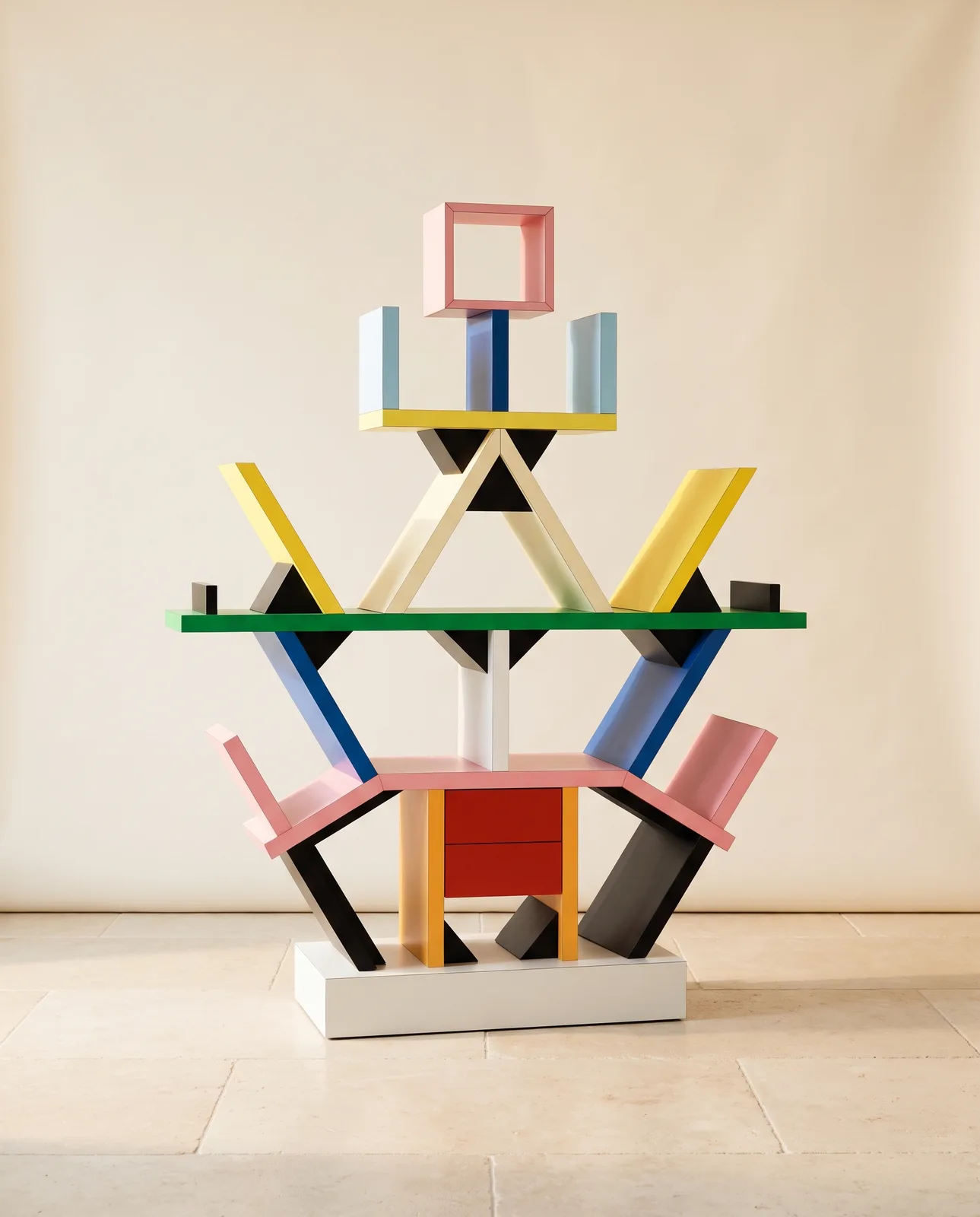
Carlton Room Divider
Ettore Sottsass — Memphis Milano, Italy
A bookshelf that looks like a colorful cartoon character or a totemic creature: Ettore Sottsass's 1981 Carlton was the Memphis movement's key piece — and a deliberate, loud break from everything that had defined good Scandinavian or minimalist furniture until then.
A design movement built to provoke
Ettore Sottsass, already an established industrial designer for companies including Olivetti, founded the Memphis Group in Milan in 1980 together with a group of younger designers. The goal was a deliberate provocation against the then-dominant "good taste" of restrained, functional design — whether Scandinavian, Bauhaus-inflected, or Italian-elegant. The Carlton, unveiled in 1981 as part of Memphis's first collection, instantly became the movement's best-known and most-photographed piece.
A silhouette like a cartoon character
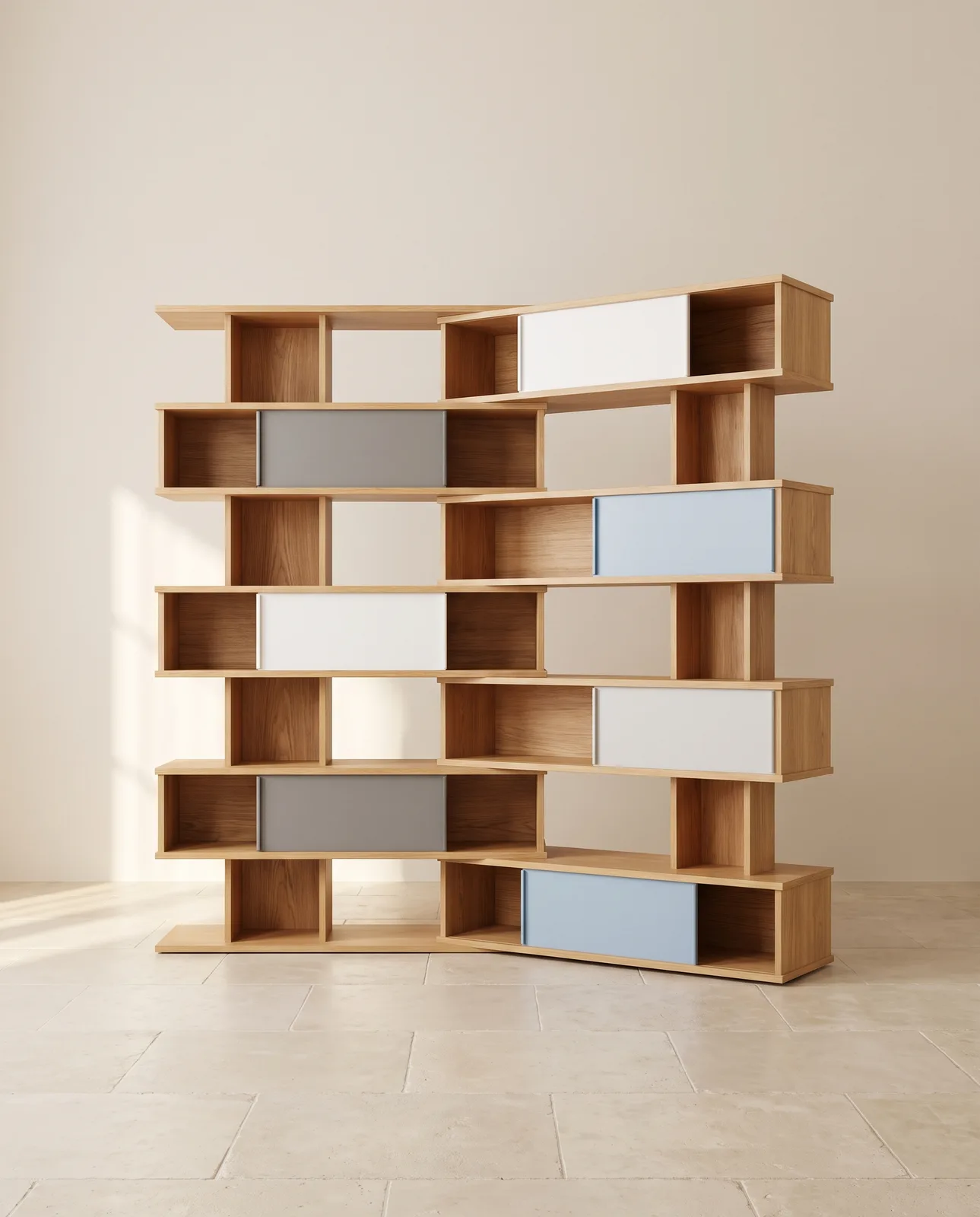
Officially, the Carlton is a bookshelf or room divider, but its form resists every classic shelving logic: asymmetrically arranged compartments and ledges jut out in different directions from a central, upright body, so the overall silhouette reads like a stylized, almost cartoon-like figure with arms and a crown-like head. The shelf is built from wood clad in colorful plastic laminate — a material deliberately chosen for feeling "cheap" at the time, which Sottsass provocatively turned into a museum-worthy piece of furniture.
Postmodernism as a counter-design to Functionalism
Stylistically, the Carlton stands for the early-1980s Postmodernism that explicitly opposed the dogma "form follows function." Instead of restraint, neutral colors, and practical usability, Sottsass chose bright primary colors, childlike, almost toy-like forms, and deliberate impracticality — the Carlton's angled shelves are barely suited to actually holding books steady. That provocation was intentional: design was meant to carry emotion, humor, and cultural statement again, not just efficiency.
From scandal object to museum piece
At its debut, the Carlton was highly polarizing — many established design critics dismissed it as childish or kitschy. Today, the shelf sits in the collections of major design museums worldwide and is regarded, in hindsight, as one of the most influential pieces of furniture of the late 20th century, one that shaped not only Postmodernism but also later movements, including the colorful 1980s aesthetic and its current revival.
The Carlton in a style mix
As a pure statement object, the Carlton works best set deliberately against a calmer backdrop: in an otherwise reduced Art Deco living room of black and gold, it delivers an unexpected color explosion; in a Modern Luxury room with marble, an appealing clash emerges between high gloss and toy-like aesthetics; and next to classic Louis XVI furnishings, the contrast between courtly heritage and postmodern rebellion becomes especially vivid.
Ateliology Style Verdict
The Carlton proves that a piece of furniture can write design history through deliberate provocation. Ettore Sottsass's break with Functionalism and good taste made it the symbol of an entire movement — and one of the loudest, yet also most influential, style pieces of the 20th century.