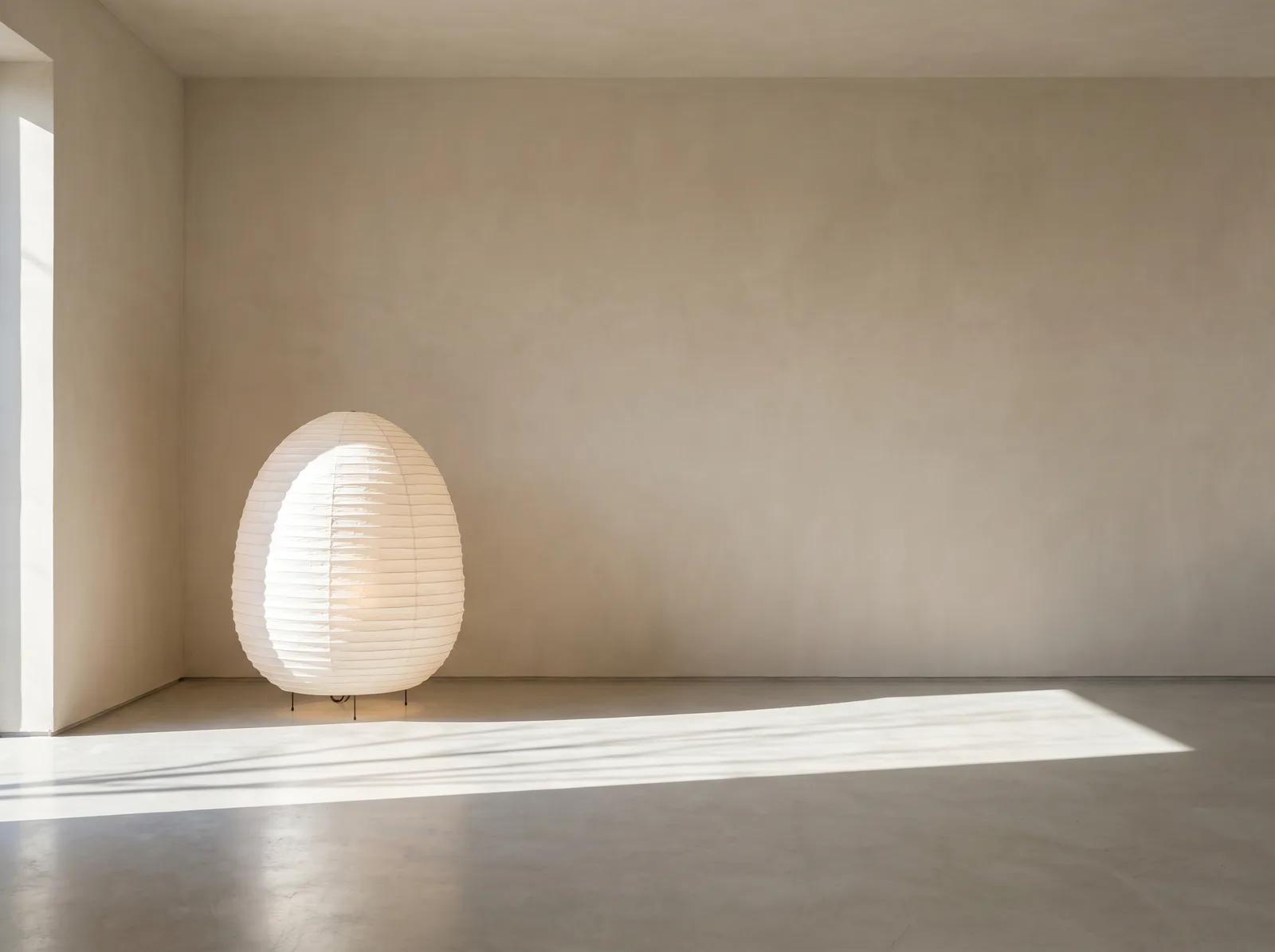
Akari Light Sculpture
Isamu Noguchi — Vitra / Ozeki, Japan
Hand-crafted washi paper over a bamboo frame turns a simple light bulb into a softly glowing object — since 1951, Isamu Noguchi's Akari light sculptures have combined traditional Japanese craft with sculptural modernism.
More Than a Paper Lantern
Isamu Noguchi himself insisted that the Akari should not be called mere lamps, but "light sculptures" — a term that fittingly captures their ambition. Made from hand-crafted washi paper over a delicate bamboo frame, the object works as a standalone sculpture just as much as a light source, and its appearance changes almost completely depending on whether it's lit or not.
A Trip to Gifu as the Starting Point
Japanese-American artist Isamu Noguchi developed the Akari series in 1951 following a visit to the Japanese city of Gifu, known for its traditional lantern and paper craft. The city's mayor had invited Noguchi to help revive the local craft, which had fallen on economically hard times after World War II. That collaboration with local artisan workshops produced a series still made in Gifu today, by the company Ozeki.
Traditional Craft Meets Western Sculpture
Each Akari lamp is made on a wooden mold frame, around which thin bamboo strips are wound before hand-crafted washi paper is applied directly over it and left to dry. Only afterward is the inner wooden frame removed, leaving just the paper-and-bamboo shell. Noguchi combined this centuries-old Japanese lantern-making technique with his own understanding of form, shaped by Western sculpture — organic, biomorphic silhouettes rather than the traditionally more cylindrical lantern shapes.
Over 200 Form Variations
Over his lifetime, Noguchi designed more than 200 different Akari forms, from slim, towering floor lamps to wide, low-slung objects. Despite this enormous variety of forms, the underlying principle always remains the same: a paper-wrapped light source that bathes the room in soft, diffuse light, with no visible shadow cast by the bulb itself.
A Cultural Legacy Between Art and Craft
The Akari series is part of the collections of major art and design museums worldwide, including the Museum of Modern Art in New York, and continues to be handmade in Gifu using the same traditional methods today. It stands as an example of how a Western-trained sculptor could not only preserve an endangered local craft but bring it to international recognition.
A Statement for Japandi and Modern Organic
The Akari light sculpture naturally fits into Japandi interiors, where its handcrafted material character and pared-back form reflect that style's appreciation for natural material, as well as into Modern Organic rooms, whose rounded silhouettes echo the lamp's biomorphic forms.
The Akari Lamp in Today's Interiors
As a floor lamp in the corner of a room, the Akari casts a warm, even light that fills the space without harsh shadows. Since the paper is sensitive to moisture, the lamp is better suited to dry indoor spaces than to bathrooms or outdoor areas.
Ateliology Style Verdict
The Akari light sculpture proves that centuries-old craft and modern sculpture can enrich each other rather than being opposites. More than seventy years after its creation, it remains an object that is simultaneously cultural heritage, artwork, and everyday utility. That is exactly what makes the Akari lamp a genuine style piece.