Back to overview
Arco Floor Lamp
1962 (Italian Modernism / Space Age)

Arco Floor Lamp

Achille & Pier Giacomo CastiglioniFlos, Italy

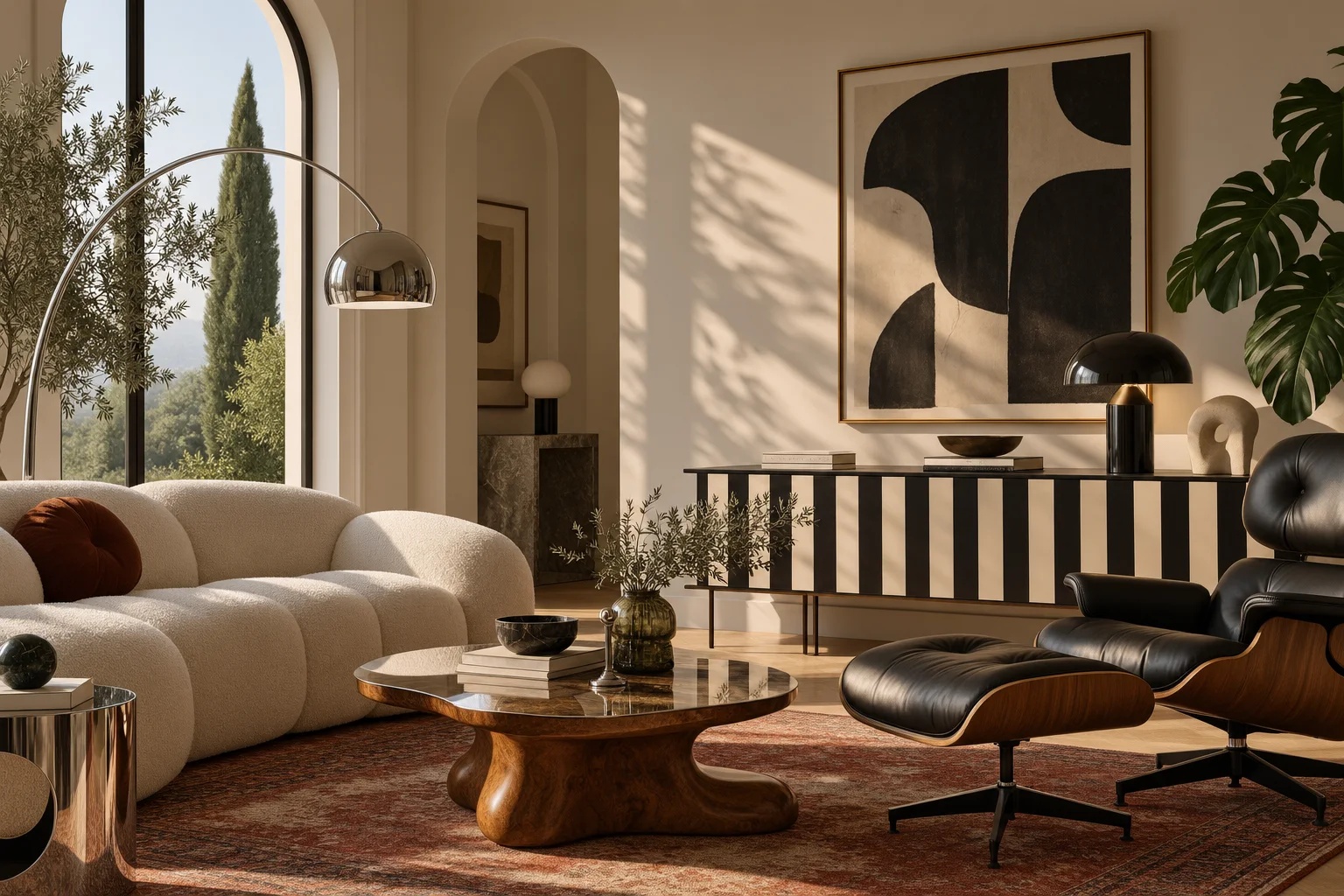
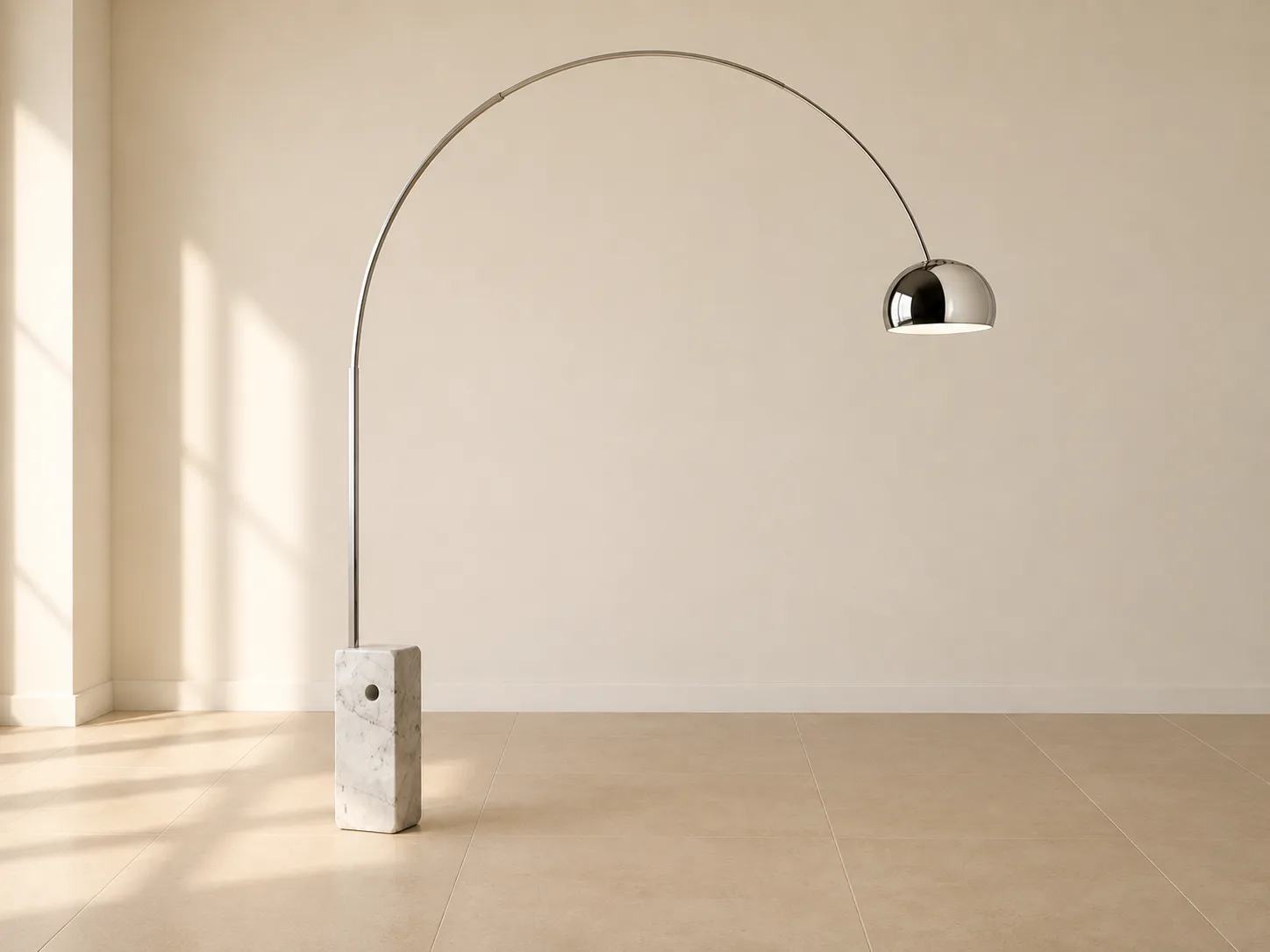
A heavy Carrara marble block, a sweeping stainless-steel arc, and a shade that hovers meters away from its base: the Arco Floor Lamp reimagined the street lamp for domestic life — and became one of the most recognizable silhouettes in twentieth-century design.

More Than Just a Lamp

Few lighting designs are as instantly recognizable as the Arco Floor Lamp. Designed in 1962 by the Italian brothers Achille and Pier Giacomo Castiglioni for Flos, the Arco transformed an everyday architectural idea into one of the most important objects of twentieth-century interior design. Its concept is remarkably simple: a heavy marble block anchors a long curved metal arm that projects light far away from the base. Yet this combination of stone, steel and polished metal created something that was simultaneously functional, architectural and sculptural. More than sixty years after its introduction, the Arco still looks contemporary. It works in Mid-Century interiors, Italian Modernism, Minimalism, Space Age settings, Brutalist rooms and even today's Modern Organic spaces. That ability to cross different eras and styles makes the Arco much more than a floor lamp. It is a true style piece.

The Story Behind the Arco Lamp

The Arco was created during one of the most important periods in Italian design. Post-war Italy experienced an extraordinary transformation during the 1950s and 1960s. Industrial production expanded rapidly, architects and designers experimented with new materials, and companies such as Flos, Artemide, Kartell and Cassina began producing objects that combined industrial manufacturing with distinctly Italian visual sophistication. Achille and Pier Giacomo Castiglioni were central figures in this movement. Their approach to design was often based on observation rather than decoration. They studied existing objects, identified practical problems and searched for surprisingly simple ways to solve them. The Arco emerged from exactly this philosophy. The brothers wanted to create the effect of a ceiling light without requiring electrical wiring or drilling into the ceiling. Their solution was almost architectural. Instead of suspending the light from above, they placed its support on the floor and extended a long curved arm over the space. The result was introduced by Flos in 1962. What initially appears to be a highly sculptural lamp was therefore born from an extremely practical question: how can you illuminate the center of a table or seating area without installing a ceiling fixture? The answer became one of the most famous lamps ever designed.

Inspiration From the Street

One of the most interesting aspects of the Arco is its connection to something far more ordinary: the street lamp. Streetlights often position their light source several meters away from the pole supporting them. This allows roads and sidewalks to be illuminated without placing the support directly underneath the light. The Castiglioni brothers translated this principle into furniture scale. The marble block functions almost like the foundation of a streetlight. From it rises a slender metal structure that curves outward before terminating in the reflective shade. It is a perfect example of the Castiglionis' ability to observe everyday infrastructure and reinterpret it for domestic life. Instead of creating an entirely new visual language, they took an existing engineering principle and refined it into an elegant object for the home.

The Marble Base

Perhaps the most distinctive element of the Arco is its massive rectangular marble base. Traditionally made from Carrara marble, the block provides the counterweight necessary to support the enormous projecting arm. This is not decorative marble applied to another structure. The stone performs an essential structural function. Without its weight, the lamp could not extend so far into the room. This gives the Arco a characteristic honesty of construction: every major material has a clear purpose. The stone provides weight. The steel creates structure. The metal shade directs the light. One particularly famous detail demonstrates the Castiglioni brothers' practical thinking. The marble block contains a circular hole. It is not simply decoration. A rod can be inserted through the opening so that two people can lift and transport the extremely heavy base more easily. It is a small functional solution that has become one of the characteristic details of the design.

The Extraordinary Arc

The lamp's defining visual feature is obviously its enormous curved stem. The long stainless-steel structure rises vertically before sweeping dramatically across the room. This curve creates tension. The marble base appears extremely heavy and static. The metal arc appears almost weightless. Together they create a balance between two opposing characteristics: mass and lightness. The lamp therefore occupies space very differently from a conventional floor lamp. A normal floor lamp tends to remain vertically connected to its base. The Arco extends horizontally into the architecture of the room. Its presence can define an entire seating or dining zone. In this sense, the Arco behaves almost like a small architectural structure rather than a conventional piece of lighting.

A Lamp That Replaces a Ceiling Light

Functionally, this is perhaps the Arco's most important innovation. Imagine a dining table positioned in the center of a room. A normal floor lamp would illuminate the area from the side. The Arco allows the shade to extend directly above the table. The effect becomes similar to a pendant light. But unlike a pendant lamp, the Arco requires no permanent installation. The same principle works above sofas, lounge chairs, coffee tables, dining tables, reading areas and conversation zones. This combination of mobility and overhead lighting remains useful even today. It also explains why countless manufacturers have subsequently produced arched floor lamps inspired by the same concept.

Italian Modernism and the Design Era

The Arco belongs to the broader world of Italian Modernism of the 1950s and 1960s. This period was characterized by an unusually productive relationship between designers and manufacturers. Rather than viewing industrial production as something that limited creativity, many Italian designers used it as a tool for experimentation. The resulting objects frequently combined three qualities: technical innovation, sculptural form and everyday usability. The Arco embodies all three. It uses industrial stainless steel. It incorporates natural Carrara marble. Its highly reflective shade has an almost futuristic appearance. Yet the lamp remains completely functional. This mixture makes the Arco difficult to place within only one stylistic category. It is clearly modernist. But it also contains elements that later became associated with Space Age design. Its polished metal surface, large sweeping arc and almost futuristic silhouette would fit naturally into the interiors of the late 1960s and 1970s. That ambiguity helped it remain relevant.

Why the Arco Is a Style Piece

A true style piece should influence an interior even when very little else is present. The Arco does exactly that. Place it in an empty room and the lamp immediately establishes scale, direction and character. The large arc draws the eye across the room. The marble base introduces natural material. The reflective shade catches surrounding light and colors. Very few lighting objects possess such a powerful silhouette. This makes the Arco particularly useful in interiors where furniture is intentionally restrained. Instead of filling a room with multiple decorative objects, one Arco lamp can become the dominant visual gesture.

The Arco in Contemporary Interiors

One of the reasons the design has survived for more than six decades is its ability to work in very different interiors. In Mid-Century Modern rooms — perhaps its most historically appropriate environment — it pairs with walnut furniture, leather seating, vintage Italian pieces and warm neutral colors, reinforcing the period without making the room feel like a replica of the 1960s. In Space Age interiors, the polished metal shade and sweeping silhouette work exceptionally well alongside rounded furniture, chrome surfaces, glossy materials and sculptural seating; in this context the Arco can appear surprisingly futuristic despite dating from 1962. The contrast with Brutalist interiors can be particularly strong: concrete walls, stone floors and heavy architectural volumes echo the solidity of the marble base, while the thin steel arc introduces a lighter element. The Arco is equally interesting in contemporary Modern Organic interiors, where travertine, plaster walls, wool textiles and warm wood soften the industrial nature of the lamp, and the Carrara marble base connects naturally with the surrounding materials. And few lamps are better suited to Minimalism: the Arco can replace both a functional light source and a decorative sculpture, and because the object itself has such a strong silhouette, very little else is necessary.

Material Contrast

Part of the Arco's visual power comes from its unusual combination of materials. The marble base is ancient and natural. The stainless steel feels industrial and precise. The reflective shade appears technological. These materials could easily conflict with one another. Instead, they create balance. The marble prevents the lamp from becoming overly mechanical. The steel prevents the marble from feeling traditional. The polished shade adds a more expressive finishing element. It is this interaction between seemingly contradictory materials that gives the Arco much of its character.

A Sculpture That Produces Light

When switched off, the Arco already functions as an object within the room. Its enormous curve defines empty space. The stem creates an almost drawn line through the interior. The marble base provides a visual starting point while the shade creates an endpoint several feet away. This makes the negative space underneath the arc part of the design. That is an unusual characteristic for furniture and lighting. Most objects are defined primarily by their physical mass. The Arco is equally defined by the empty space it surrounds. This is one reason it photographs so well and why it remains particularly attractive in architectural interiors.

Why the Design Still Feels Contemporary

Like many of the strongest twentieth-century furniture icons, the Arco avoids excessive decoration. There are no patterns. No unnecessary ornament. No fashionable colors permanently attached to the design. Instead, its identity comes from geometry and material. Those qualities age considerably more slowly. The same lamp can therefore look completely different depending on its environment. Against white walls, it feels minimalist. Against concrete, it becomes architectural. Within a colorful 1970s-inspired interior, it feels retro-futuristic. Surrounded by beige stone and natural textiles, it becomes Modern Organic. That adaptability is a defining characteristic of timeless design.

Ateliology Style Verdict

The Arco Floor Lamp demonstrates that iconic design does not necessarily require complexity. Its concept can almost be explained in one sentence: move a ceiling light onto the floor. But the execution transforms that simple idea into something extraordinary. The Castiglioni brothers created a lamp in which virtually every visual element also performs a practical function. The marble is heavy because it needs to be. The arc is large because it needs to reach across the room. The shade hangs far away from the base because that is the fundamental purpose of the lamp. Yet together these functional decisions form one of the most recognizable silhouettes in design history. The Arco therefore represents several contrasts simultaneously: heavy and weightless, natural and industrial, architectural and domestic, functional and sculptural, 1960s and contemporary. More than sixty years after its introduction, countless arched floor lamps continue to borrow its basic idea. But the original remains distinctive because its proportions, materials and engineering form such a coherent whole. That is ultimately what separates an attractive lamp from a genuine furniture icon. The Arco does not simply illuminate a room — it becomes part of its architecture. And that is precisely what makes the Arco Floor Lamp a true style piece.