Back to overview
PH Artichoke Lamp
1958 (Danish Modern)
PH Artichoke Lamp

Poul HenningsenLouis Poulsen, Denmark

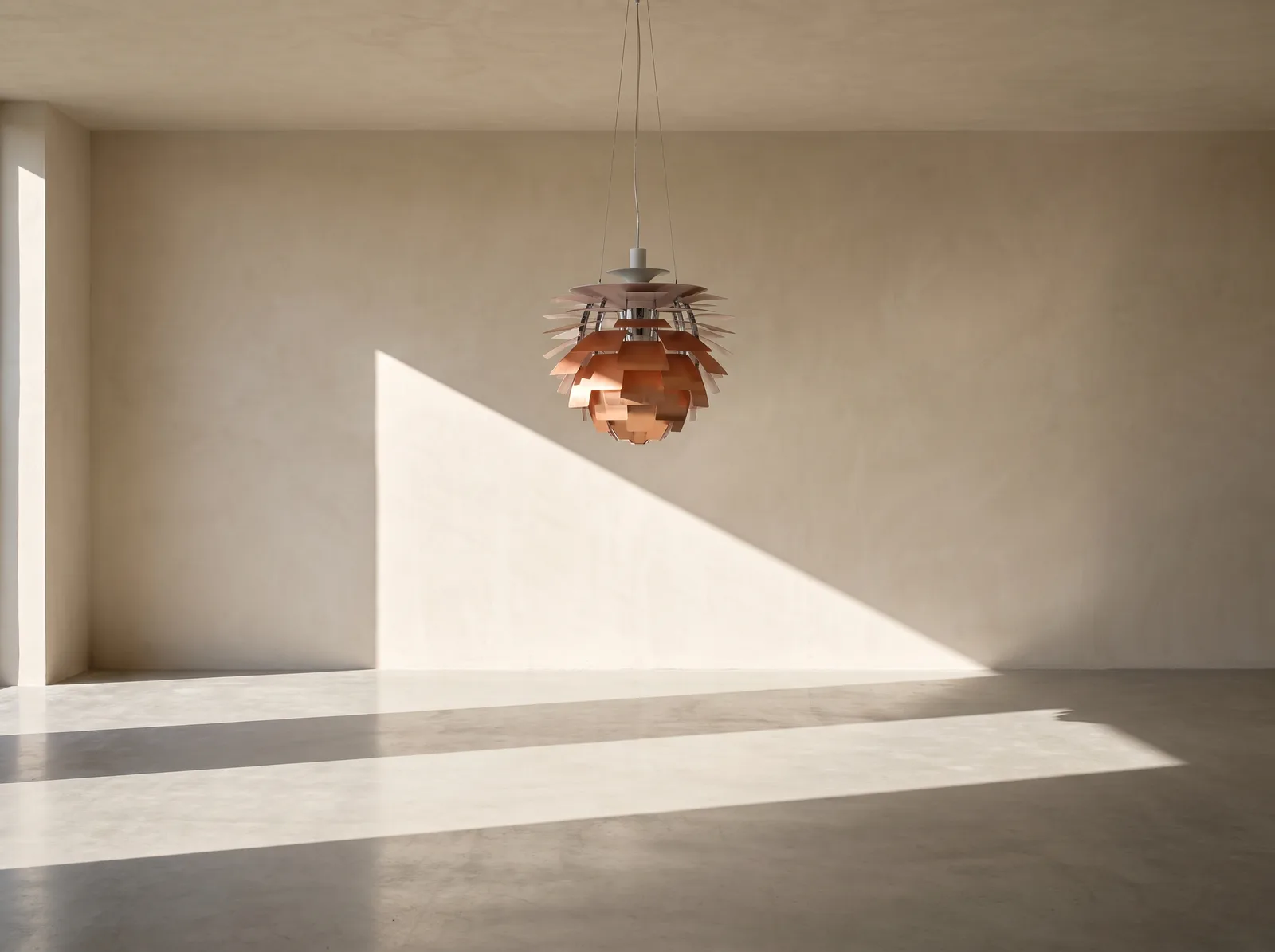
Twelve rows of 72 staggered copper leaves completely conceal the bulb — the PH Artichoke was designed in 1958, almost by accident, for a Copenhagen restaurant, and is now considered one of the most complex lamps in design history.

More Than a Pendant Lamp

The PH Artichoke is one of the most complex lighting objects ever mass-produced: 72 individual, copper-toned leaves are arranged in twelve staggered rows in a circular pattern, completely concealing the bulb from every angle. The result is a warm, entirely glare-free light that illuminates the room evenly, without the light source itself ever becoming visible.

An Accidental Creation for a Copenhagen Restaurant

Poul Henningsen, who had already spent decades researching glare-free lighting, designed the Artichoke in 1958 for a very specific, practical occasion: the reopening of Copenhagen's Langelinie Pavillonen restaurant. The design was meant to solve a particular challenge — large-scale but glare-free lighting for an open dining room — but proved so successful that Louis Poulsen soon added it to the regular collection.

A Lifetime of Research Into Glare-Free Light

The Artichoke was the culmination of Henningsen's decades-long engagement with the so-called PH lamp series, named after his initials, in which he systematically studied how light could be directed through multi-layered, staggered shades to avoid any direct glare. Each individual leaf of the Artichoke is positioned at a precise angle, based on those decades of optical calculations.

Handcrafted Despite Industrial Production

Although the Artichoke has been in series production for over sixty years, assembling each individual lamp still requires considerable manual effort today: each of the 72 leaves must be attached to the frame by hand, a process that takes several hours per lamp. This combination of industrial mass production and manual final assembly is characteristic of many Danish design icons from that era.

An Icon of Danish Modern

The PH Artichoke is now one of the most recognized symbols of Danish design, and it's no coincidence that it adorns numerous public buildings and institutions in Denmark, including the Danish Parliament. It sits in the collections of major design museums worldwide and continues to be produced by Louis Poulsen today in several sizes and material finishes.

A Statement for Mid-Century and Modern Luxury

The PH Artichoke works as a room-filling statement over a dining table in Mid-Century interiors just as well as it does as a dramatic focal point in Modern Luxury rooms, where its copper-toned, sculptural form radiates both opulence and technical refinement.

The PH Artichoke in Today's Interiors

Given its size, the Artichoke shows its full effect best over a generous dining table or in a tall stairwell, where there's enough vertical space to let the full silhouette shine. Smaller size variants are available for more compact rooms, offering the same glare-free light on a smaller scale.

Ateliology Style Verdict

The PH Artichoke proves that decades of technical research can result in an object of extraordinary visual beauty. Born from a concrete restaurant commission, it remains one of the most complex and coveted design icons in existence. That is exactly what makes the PH Artichoke a genuine style piece.