Back to overview
Womb Chair
1948 (American Modern)
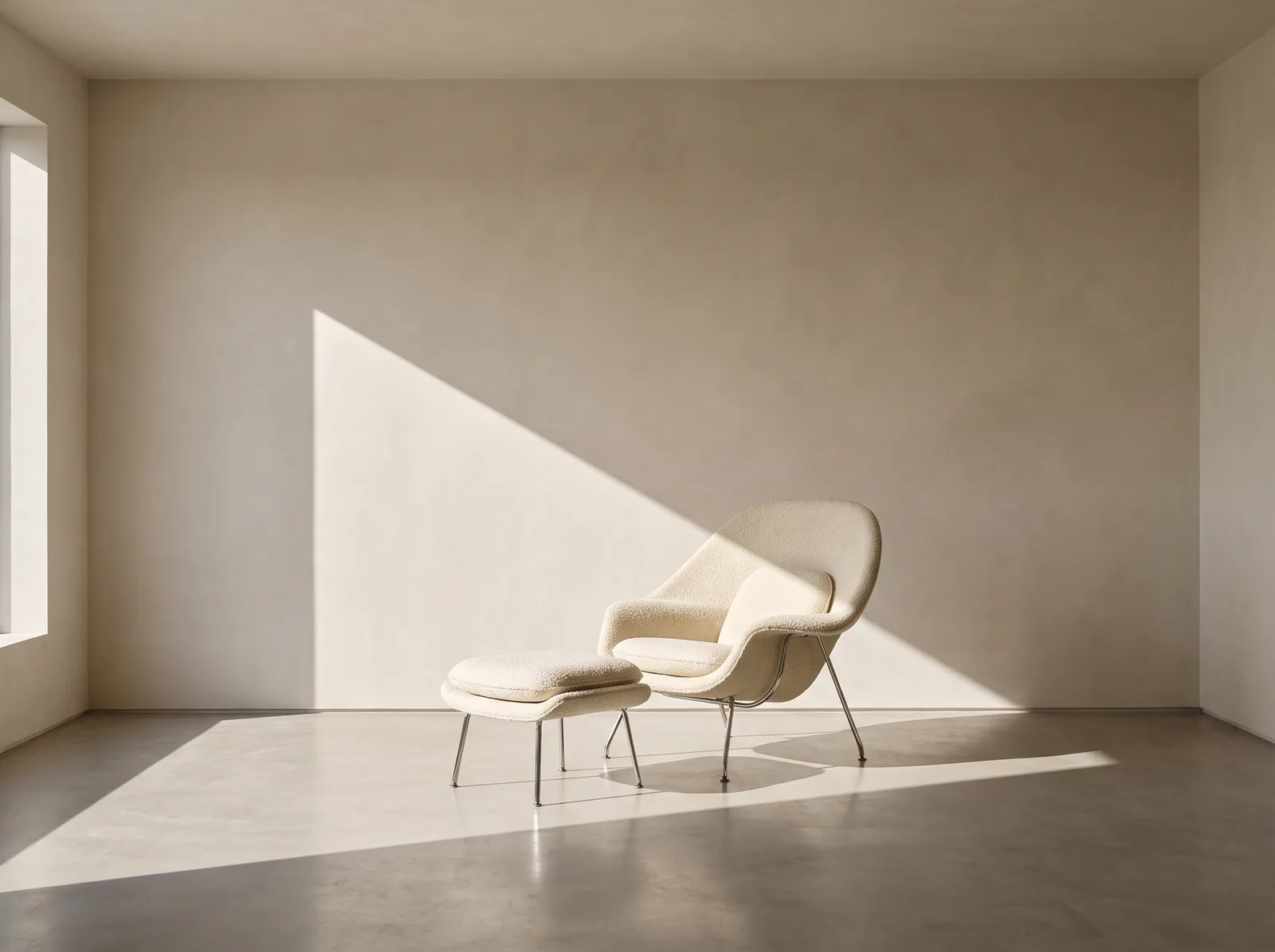
Womb Chair

Eero SaarinenKnoll, USA

Designed at the request of a client who wanted a chair "she could curl up in" — in 1948, the Womb Chair became one of the first pieces of furniture deliberately designed around psychological comfort rather than just a place to sit.

More Than an Armchair

Most armchairs are designed to look good and sit comfortably. The Womb Chair was designed to feel safe — a subtle but decisive difference. Its deep, enveloping shell shape, upholstered and wrapped in warm fabric, practically invites you to pull your legs in and curl up rather than sit upright. That almost protective quality earned the chair its lasting name shortly after its 1948 introduction: the Womb Chair.

A Commission From Florence Knoll

The Womb Chair was created at the explicit request of Florence Knoll, co-founder of the furniture company Knoll and one of the most influential figures in 20th-century American furniture design. She asked her longtime friend and former classmate Eero Saarinen for a chair "she could retreat into like her shell" — an unusually personal and emotional design brief for its time, when furniture designs were typically justified in purely functional or formal terms.

A One-Piece Fiberglass Shell

Constructively, the Womb Chair was an early pioneer: its curved base form is a single fiberglass shell, reinforced with a slim, chrome-plated steel frame — a technique Saarinen had developed just a few years earlier together with Charles Eames for the Organic Chair. The shell is fully upholstered and covered, so the technical construction stays hidden, leaving only the soft, organic form that gives the chair its character.

American Modern and Organic Design

The Womb Chair emerged during a period when American designers began moving away from the strict geometry of European functionalism toward softer, biomorphic forms. Saarinen, a Finnish-American architect and designer, was a central figure in this development, later referred to as organic design. The Womb Chair exemplifies this transitional moment: technically advanced in its fiberglass construction, but already formally oriented entirely around emotion and well-being.

From Living Room to Museum

The Womb Chair quickly became a commercial success for Knoll and has remained part of the company's permanent collection for decades — a remarkably long production life for a chair design. It also sits in the collections of major design museums, including the Museum of Modern Art in New York, and is considered one of the most influential American furniture pieces of the post-war era. It's frequently sold together with its matching ottoman, which reinforces the enveloping, sheltered seating posture even further.

A Statement for Mid-Century and Modern Organic

The Womb Chair naturally fits into classic Mid-Century interiors, where its slim steel frame and era-appropriate form sit comfortably alongside walnut furniture and geometric textures. It works just as well in Modern Organic rooms, whose rounded silhouettes and nature-inspired material palette echo the chair's soft, biomorphic shape. In both contexts, the appeal lies in the fact that despite its size, the Womb Chair never feels heavy or bulky — its rounded form visually removes weight that an angular chair of the same size wouldn't.

The Womb Chair in Today's Interiors

Paired with its matching ottoman in a reading corner, the Womb Chair shows its full effect, especially when placed slightly apart from the main seating area to create its own quieter retreat within the room. In open-plan living spaces, it often takes on the role of a second, more informal seat alongside a more classic sofa. Warm, textured upholstery such as bouclé or wool blends further reinforces the chair's sense of shelter.

Ateliology Style Verdict

The Womb Chair was one of the first pieces of furniture deliberately designed to create a feeling rather than just a seating position — and it still delivers on that promise today. Born from a personal wish for comfort and shelter, it has been in continuous production for more than 75 years without losing any of its emotional impact. That rare combination of technical innovation and emotional design is exactly what makes the Womb Chair a genuine style piece.