Platner Wire Chair
Warren Platner — Knoll, USA
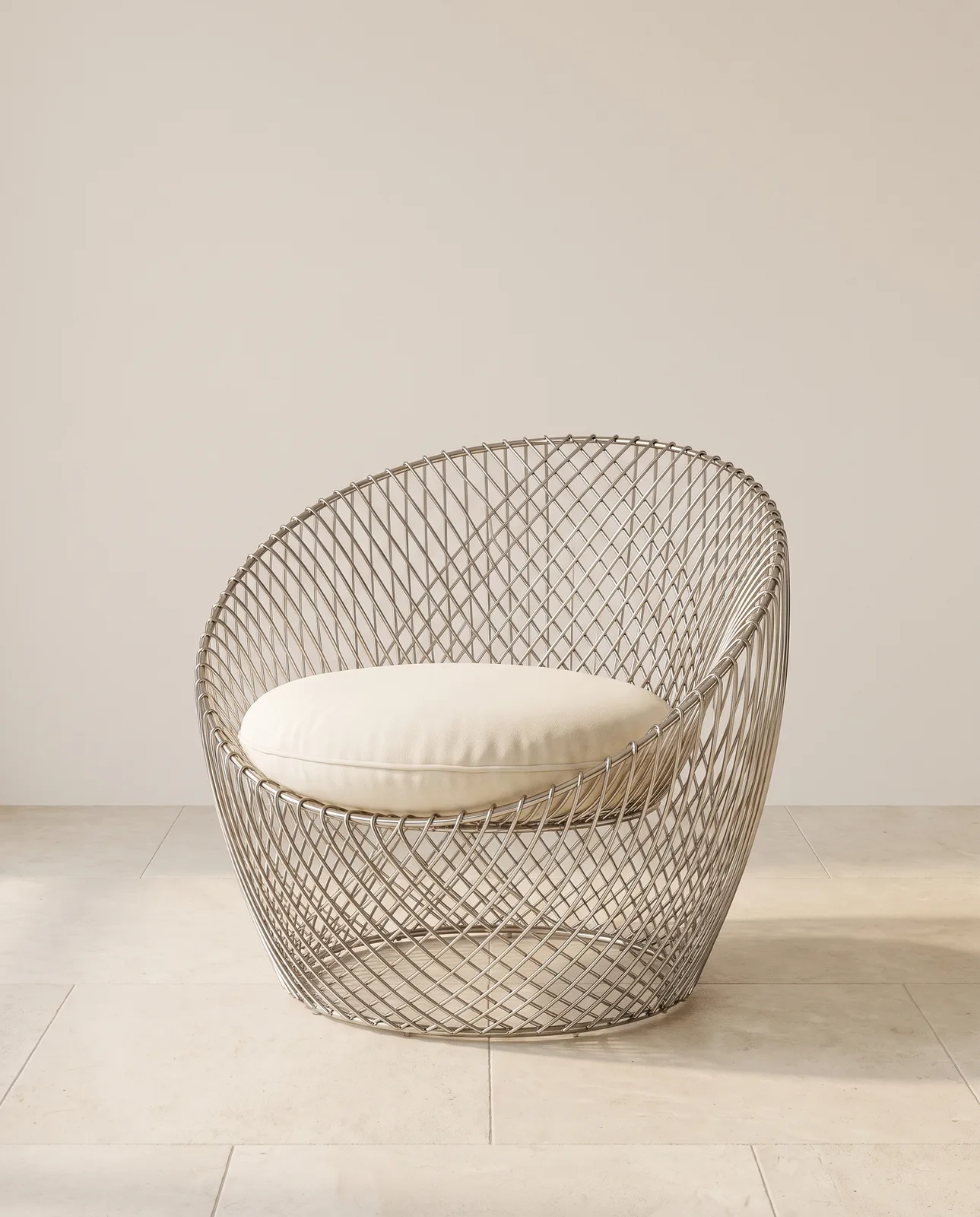
Hundreds of curved steel wires, welded radially into a basket form: Warren Platner's 1966 chair turns a lounge chair into an optical object whose wire pattern shifts with the viewing angle — inspired, Platner said, by the structure of a bird's nest.
An architect designs an entire collection
Warren Platner was first and foremost an architect, having worked with figures including Eero Saarinen and I. M. Pei before designing a complete furniture collection for Knoll in 1966 — lounge chairs, armchairs, side tables, dining tables, and ottomans, all built from the same distinctive wire construction. Platner said he wanted to continue neither the cool minimalism of Bauhaus tubular steel nor the soft organics of Saarinen's shell forms, but to create something explicitly decorative and "romantic" within a modernist form language.
The construction: hundreds of wires, one pattern
Every seating piece in the collection is built from numerous vertical steel rods arranged radially into a half-circle and welded to a ring of nickel- or bronze-finished steel — an unusually labor-intensive production process for its time, requiring each rod to be positioned with precision to create the characteristic moiré pattern. That optical shimmer shifts with viewing angle and light, making the chair a piece of furniture that constantly reveals itself differently as you move around the room.
Between Mid-Century Modern and Space Age
The Platner Chair emerged right at the transition between late Mid-Century Modern and the emerging Space Age design of the late 1960s. Its metallic, almost futuristic wire structure anticipates form ideas that would soon become popular in Space Age design with chrome and transparent acrylic, while the chair's underlying proportions still sit clearly within the Mid-Century tradition. That stylistic in-between position makes it especially versatile for fusions drawing on both eras.
Light as a design tool
Because the wire construction is nearly transparent, the Platner Chair also functions as a tool for staging light: it casts fine, net-like shadows on the floor and wall that shift with the sun over the course of a day, while leaving sightlines open across the room that an opaque piece of furniture would block. In smaller rooms, it therefore feels considerably less space-consuming than its actual dimensions would suggest.
The Platner Chair in a style mix
The chair works beautifully next to smooth, glossy Space Age surfaces in chrome or lacquer, but it also complements Modern Organic interiors, since its delicate wire pattern provides a natural counterweight to heavy natural materials like limestone or coarse linen. In a Vintage room with dark walnut, it creates an appealing material contrast between metal and wood, while in an Art Deco interior it adds a transparent, lighter note to the era's geometric rigor.
Ateliology Style Verdict
The Platner Chair shows that a piece of furniture can also function as a pure light object. Its sheer manufacturing complexity, its optical shimmer, and its stylistic position between two design eras make it one of the 20th century's most unusual style pieces.