Back to overview
Serpentine Sofa
1950s (American Mid-Century Modern)

Serpentine Sofa

Vladimir KaganVladimir Kagan Designs, USA

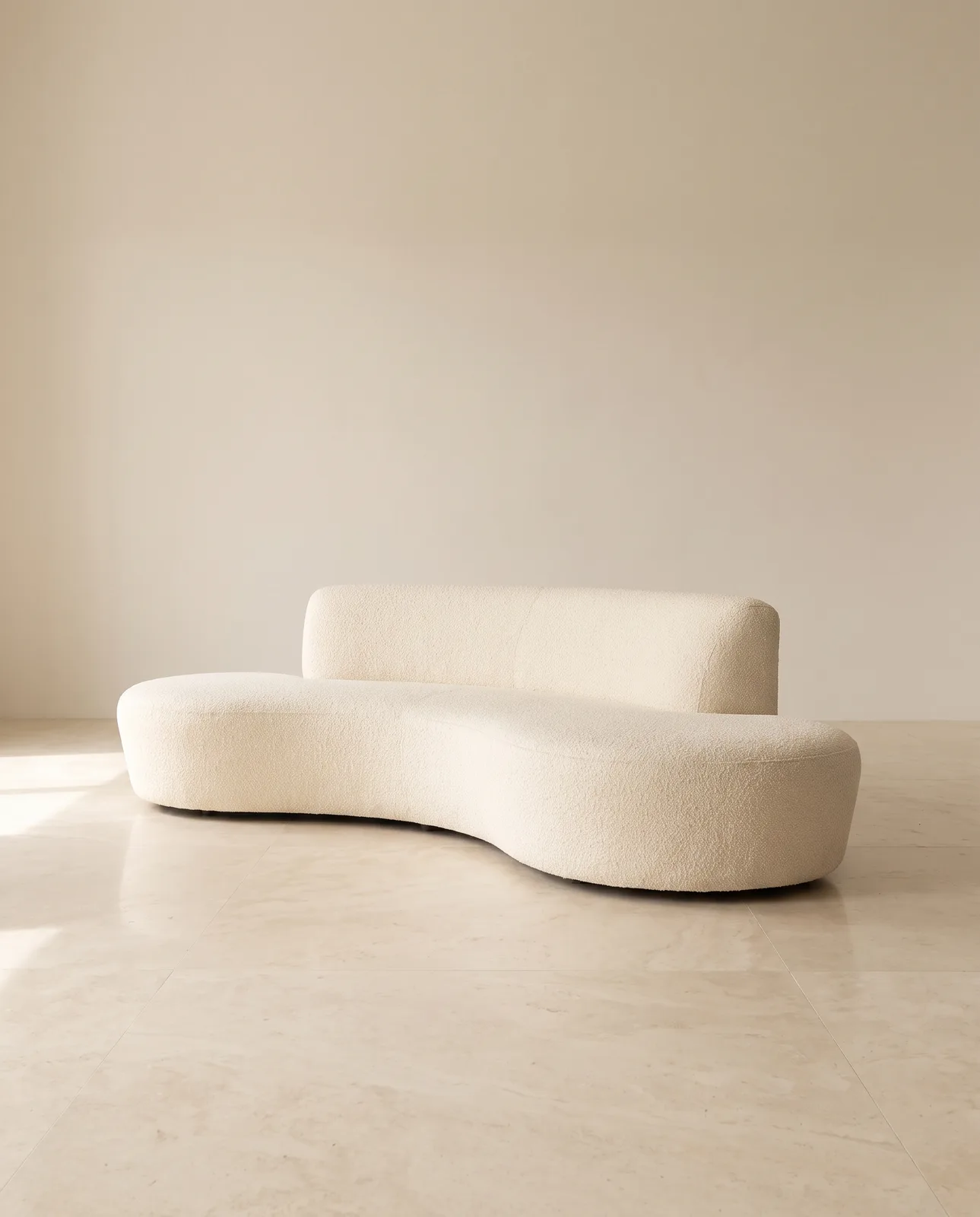
A sofa with not one straight line: Vladimir Kagan's 1950s Serpentine Sofa curves through the room in one continuous S-shape, and it made this German-born New York designer a pioneer of American organic furniture-making.

An émigré shapes New York design

Vladimir Kagan was born in Germany in 1927 and emigrated with his family to the United States in 1938, where his father, a furniture maker, opened his own workshop in New York. Kagan learned the craft directly in his father's shop and was already realizing his own designs by the late 1940s. At a time when American furniture design was heavily shaped by Scandinavian and Bauhaus influences, Kagan developed a distinctly sculptural form language of his own, one built around free, sweeping curves rather than geometric clarity.

One continuous curve instead of seating segments

The Serpentine Sofa dispenses entirely with visible seating segments or armrests in the classic sense. Instead, the entire body traces a single, continuous S-curve that winds elegantly through the room — hence the name. That shape was technically demanding for 1950s upholstery methods, since the padding had to follow the doubly curved silhouette exactly, without creating folds or tension at the transitions. Kagan generally favored smooth, solid-colored fabrics like boucle or velvet, which let the flowing form read without visual interruption.

Biomorphic Modernism instead of geometric rigor

Kagan's work is best placed within Biomorphic Modernism — a design current that existed alongside the geometrically rigorous mainstream of Mid-Century Modern, drawing instead on organic, biological forms, similar in spirit to some work by Isamu Noguchi or Eero Saarinen, but applied more consistently to large-scale upholstered seating. While many of his contemporaries favored tubular steel and right angles, Kagan proved that even large-format upholstered furniture could be shaped in a radically sculptural way.

A piece of furniture that shapes the floor plan

Because the Serpentine Sofa has no straight back, it doesn't work like a classic sofa pushed against a wall — it's conceived as a freestanding, space-defining object meant to be seen from every side. In open floor plans, it can therefore help organize the space itself, gently marking off a seating area from the rest of the room without needing a physical wall — a function that goes well beyond simple seating.

The Serpentine Sofa in a style mix

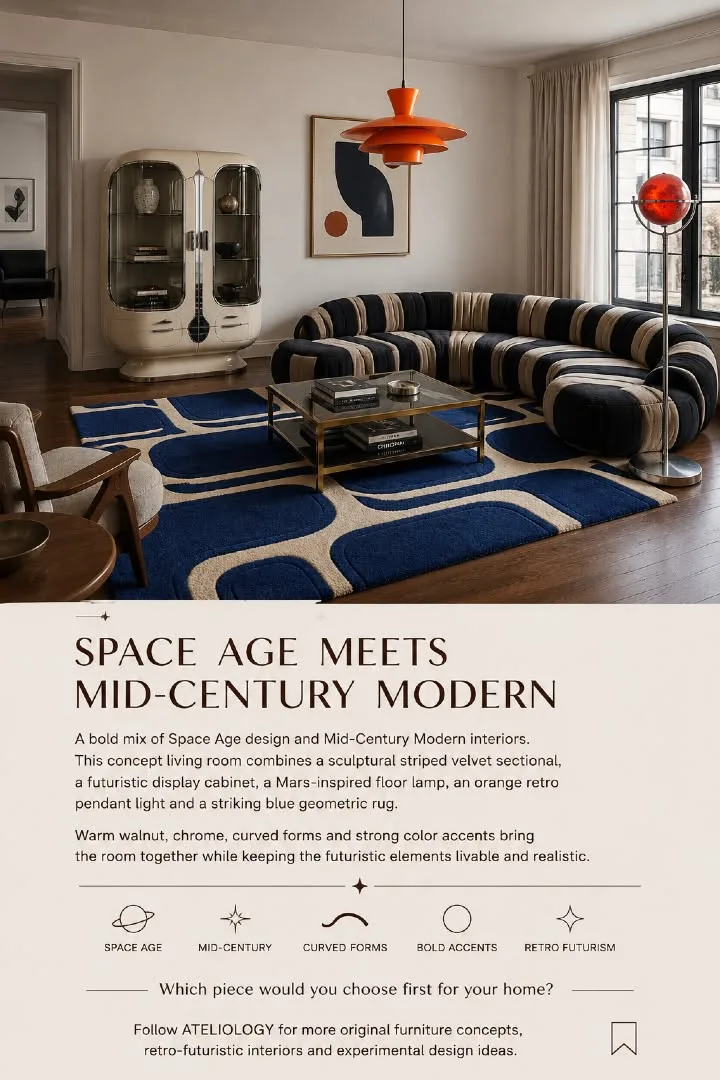
In cream boucle, the Serpentine Sofa adds a sculptural seating element to Modern Organic rooms built on limewash plaster and natural stone, while in bold colors it also works as a surprising statement in a Memphis or Pop Art interior. Next to clean, geometric Space Age objects, an appealing formal contrast emerges between free curve and exact geometry, and in a Vintage room with dark wood, its flowing silhouette reads as a modern counterweight to more classical furniture forms.

Ateliology Style Verdict

The Serpentine Sofa proves that seating doesn't have to break down into segments of back, seat, and arm — Vladimir Kagan instead conceived the sofa as one single, continuous gesture. That uncompromising form makes it one of the most sculptural style pieces in American furniture Modernism.