LC3 Grand Confort Sofa
Le Corbusier, Charlotte Perriand, Pierre Jeanneret — Cassina, Italy (licensed production)
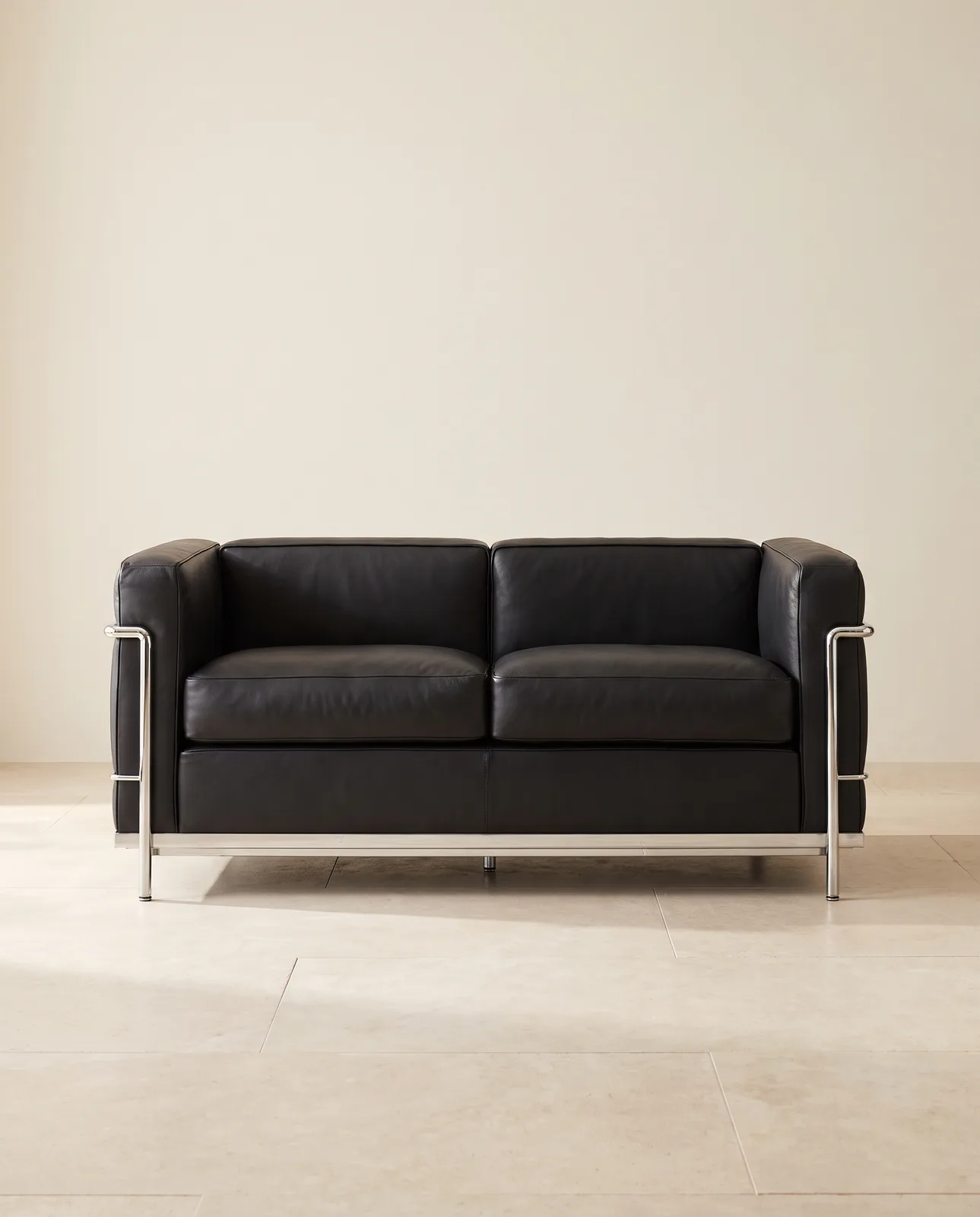
Thick leather cushions clamped inside a square cage of chromed tubular steel: in 1928, the LC3 Grand Confort turned the comfort of an English club chair into an openly visible construction — Le Corbusier himself called it "the cushion basket."
The club chair, rethought
Like the LC4, the LC3 Grand Confort emerged in 1928 from the team of Le Corbusier, Charlotte Perriand, and Pierre Jeanneret, and was first shown publicly in 1929. Its starting point was, paradoxically, a very traditional piece of furniture: the deeply upholstered English club chair, as found in studies and libraries. Le Corbusier wanted to preserve that comfort while exposing the hidden internal construction of springs and webbing, translating it into a clearly legible industrial framework instead.
The cage as visible construction
The result is a square outer frame of chromed tubular steel, built like a cage around thick, loosely inserted leather cushions. Unlike a classic sofa where the upholstery is fixed permanently to the frame, the LC3's cushions sit visibly within the steel structure — structure and comfort are deliberately treated as two separate, equally weighted elements. Le Corbusier himself called it, with a touch of humor, "coussins-corbeille" — the cushion basket.
A statement for honest construction
Stylistically, the LC3 stands for a central principle of early Modernism: not hiding a piece of furniture's construction, but making it the actual design subject. That idea of "honest construction" shaped not only furniture Modernism but also the concurrent architecture of the Bauhaus movement, where structural elements likewise stayed deliberately visible rather than hidden behind ornament. The LC3 sofa translates that architectural thinking directly into a piece of seating.
Why black leather emphasizes the construction
In black leather, the classic execution, the contrast between matte chrome and glossy dark upholstery stands out especially clearly — the cushions read almost as objects in their own right within the frame. Lighter leather tones or fabric covers make the sofa feel cozier and less severe, but they also soften the original conceptual contrast between structure and cushion that Le Corbusier deliberately sought.
The LC3 in a style mix
The LC3 sofa works beautifully alongside other pieces from the same form language — the LC10-P table or the LC4 chaise longue — but also forms compelling combinations outside its own family: next to Brutalist concrete, it creates a coherent material family of industry and raw construction; in a Modern Luxury room with marble, its cool chrome adds an elegant counterpoint; and even beside a historicist Louis XVI console, a charged dialogue emerges between two radically different ideas of elegance.
Ateliology Style Verdict
The LC3 Grand Confort shows how a traditional piece of furniture can become something entirely new through the consistent exposure of its own construction. Nearly a century after it was created, it remains a textbook example of structure itself becoming design — an uncompromising style piece.