Tulip Table
Eero Saarinen — Knoll, USA
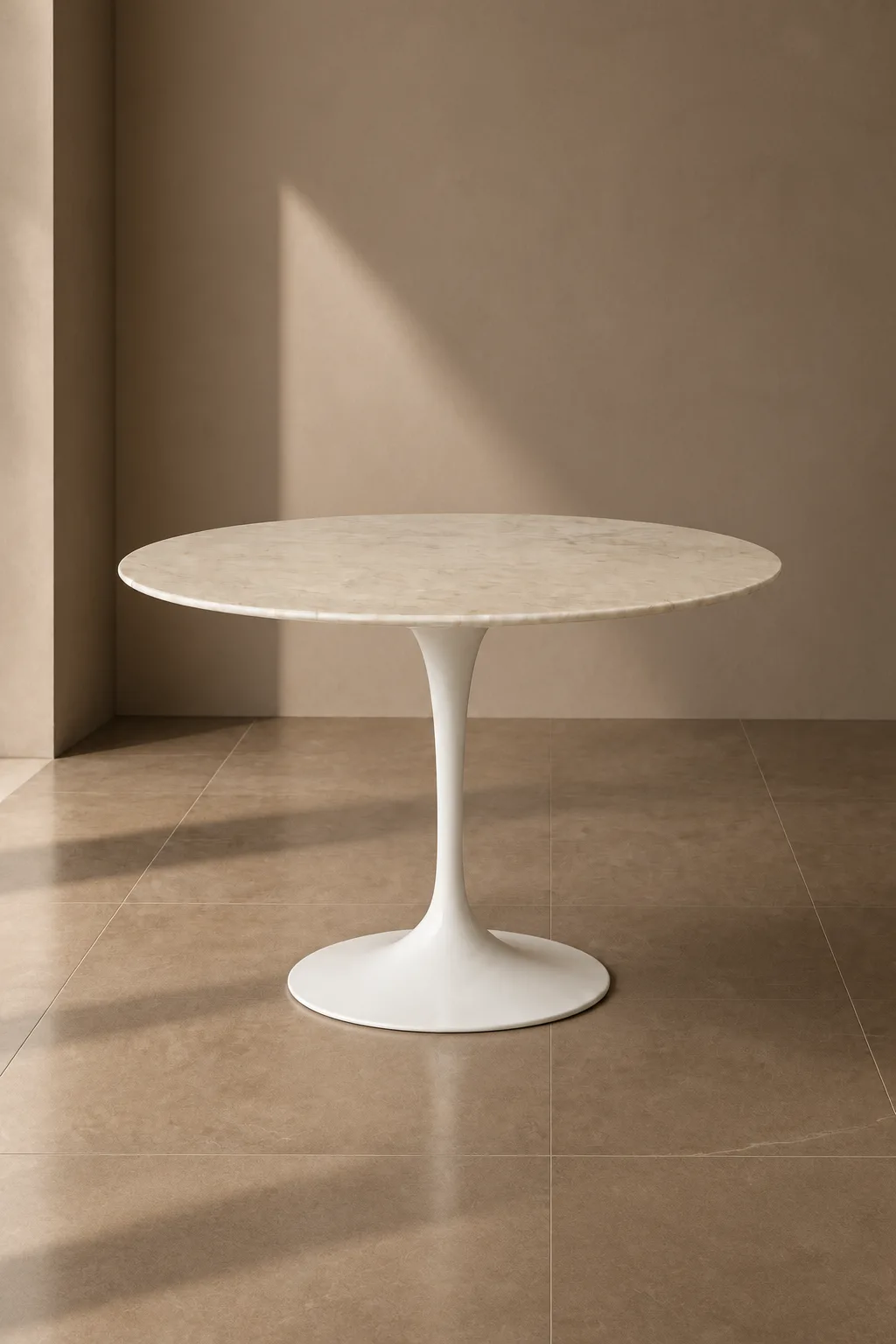
A single sculptural pedestal replacing four legs, a tabletop that seems to float above the floor: the Tulip Table is Eero Saarinen's answer to what he called the "slum of legs" beneath modern furniture — and one of the most recognizable silhouettes in design history.
A Table Built to Disappear
Nearly seventy years after Eero Saarinen developed the Pedestal Collection for Knoll in 1956, its basic proposition remains compelling: remove the visual clutter, simplify the structure, and let one strong form do the work. That is why the Tulip Table is not merely a famous table. It is one of the defining silhouettes of modern furniture design — a single sculptural stem rising from a round base and flaring into a tabletop, with no legs, no stretchers, nothing to interrupt the eye.
The Problem Saarinen Set Out to Solve
Saarinen's starting point wasn't aesthetic — it was a complaint about clutter. He was famously bothered by what he called the "slum of legs" created wherever tables and chairs met in a room: four legs per chair, four per table, all crossing and competing beneath the furniture, breaking up the floor into a chaotic thicket of verticals. His goal with the Pedestal Collection, launched in 1956, was to give tables and chairs a single, unbroken support — "to make the chair all one thing again," as he put it — so that a dining setting would read as a few clean, sculptural forms rather than a forest of legs.
The Pedestal Collection: Table and Chair as One Family
The Tulip Table never stood alone in Saarinen's design — it was conceived alongside the matching Tulip Chair, together forming the Pedestal Collection. Both pieces shared the same visual grammar: a wide, stable base tapering into a slender stem before opening back out into the functional surface, whether a tabletop or a seat shell. Seen together around a dining table, the collection produced exactly the effect Saarinen wanted — a room where furniture reads as a set of unified sculptural gestures rather than a collection of separate legs and frames.
A Single-Material Vision That Technology Couldn't Yet Deliver
Saarinen's original ambition was even more radical than the finished product: he wanted the entire piece — base and top alike — molded from a single material, so the table would look genuinely seamless, almost grown rather than built. The plastics and composite technology of the mid-1950s, however, wasn't yet capable of producing a pedestal strong enough to support a tabletop on its own. The compromise that shipped was a cast aluminum base, finished in a durable coating — usually white, though black and other colors exist — engineered to visually disappear into the tabletop material rather than announce itself as a separate structural part. It's a reminder that even the most apparently effortless designs are often the result of negotiating between an idea and what could actually be manufactured at the time.
Marble, Laminate, and the Many Faces of One Silhouette
Despite its single, unmistakable base, the Tulip Table has never had just one look. Knoll has produced tabletops in laminate and wood veneer since the 1950s, and today also offers natural stone versions in marble and other materials — the option most associated with the table's current status as a design object rather than a purely functional dining piece. A white laminate top reads as clean, functional Mid-Century Modern; a veined marble top pushes the same silhouette toward something closer to modern luxury, letting the organic pattern of the stone contrast with the machine-precision curve of the base. The base color matters just as much: white keeps the whole object visually weightless, while a black base grounds it and gives the tabletop more visual independence.
Mid-Century Modern Meets Space Age
Stylistically, the Tulip Table is usually filed under Mid-Century Modern, and its 1956 date places it firmly within that era. But the pedestal's smooth, biomorphic curve — closer to a piece of abstract sculpture or a wine glass stem than to any traditional table leg — also points forward to the Space Age design that would dominate the following decade. Saarinen wasn't alone in this: several designers of the mid-1950s were beginning to treat furniture bases less as structural necessities and more as sculptural statements, anticipating the more overtly futuristic forms of the 1960s. The Tulip Table sits right at that hinge point — modern enough to belong to its own decade, futuristic enough to comfortably share a room with later Space Age pieces.
From Design Object to Cultural Shorthand
Few pieces of furniture have crossed as fully into general visual culture as the Tulip Table. Its silhouette has appeared in countless films, television sets, and advertisements as an instant visual shorthand for the mid-century era — sleek, optimistic, unmistakably modern. That ubiquity is a double-edged legacy: it's a genuine mark of design success, but it has also made the Tulip Table one of the most widely copied pieces in furniture history, with low-cost reproductions available at nearly every price point. The original, produced under license by Knoll, remains the only version tied to Saarinen's actual design and manufacturing standards — everything else is, to varying degrees, an homage.
Why the Tulip Table Still Works Today
The Tulip Table's staying power comes down to the same logic Saarinen started with: fewer visual interruptions read as calmer, more considered, more spacious — qualities that are, if anything, more in demand in interiors today than they were in 1956. In small dining spaces especially, a pedestal base solves a real practical problem alongside the aesthetic one: there are no legs to navigate around, so more chairs and more people can comfortably fit around the same table. It's a rare case of a design solving both a visual and a functional problem with the same single gesture.
Styling the Tulip Table Today
The Tulip Table's calm, sculptural base makes it a flexible anchor across several interior styles rather than a piece locked into one look. Paired with the original Tulip Chairs, it reads as pure, historically faithful Mid-Century Modern. Swapped for wishbone-style wood chairs or woven rattan seating, it shifts toward Japandi or Modern Organic warmth. Surrounded by chrome-and-glass lighting and bold graphic art, it leans into Space Age territory. And with a veined marble top and minimal styling — a single ceramic vase, nothing else — it becomes a quiet Modern Luxury statement. Few pedestal-based tables offer this much range from one unchanged silhouette.
Ateliology Style Verdict
The Tulip Table proves that removing something can be more powerful than adding it. Saarinen didn't decorate the underside of a table — he eliminated the problem entirely, and in doing so created one of the most recognizable silhouettes in modern design. Whichever top and chairs you pair it with, its real job stays the same: to let a dining space breathe.