Back to overview
E1027 Adjustable Table
1927 (early Modernism)
E1027 Adjustable Table

Eileen GrayClassiCon, Germany (licensed production)

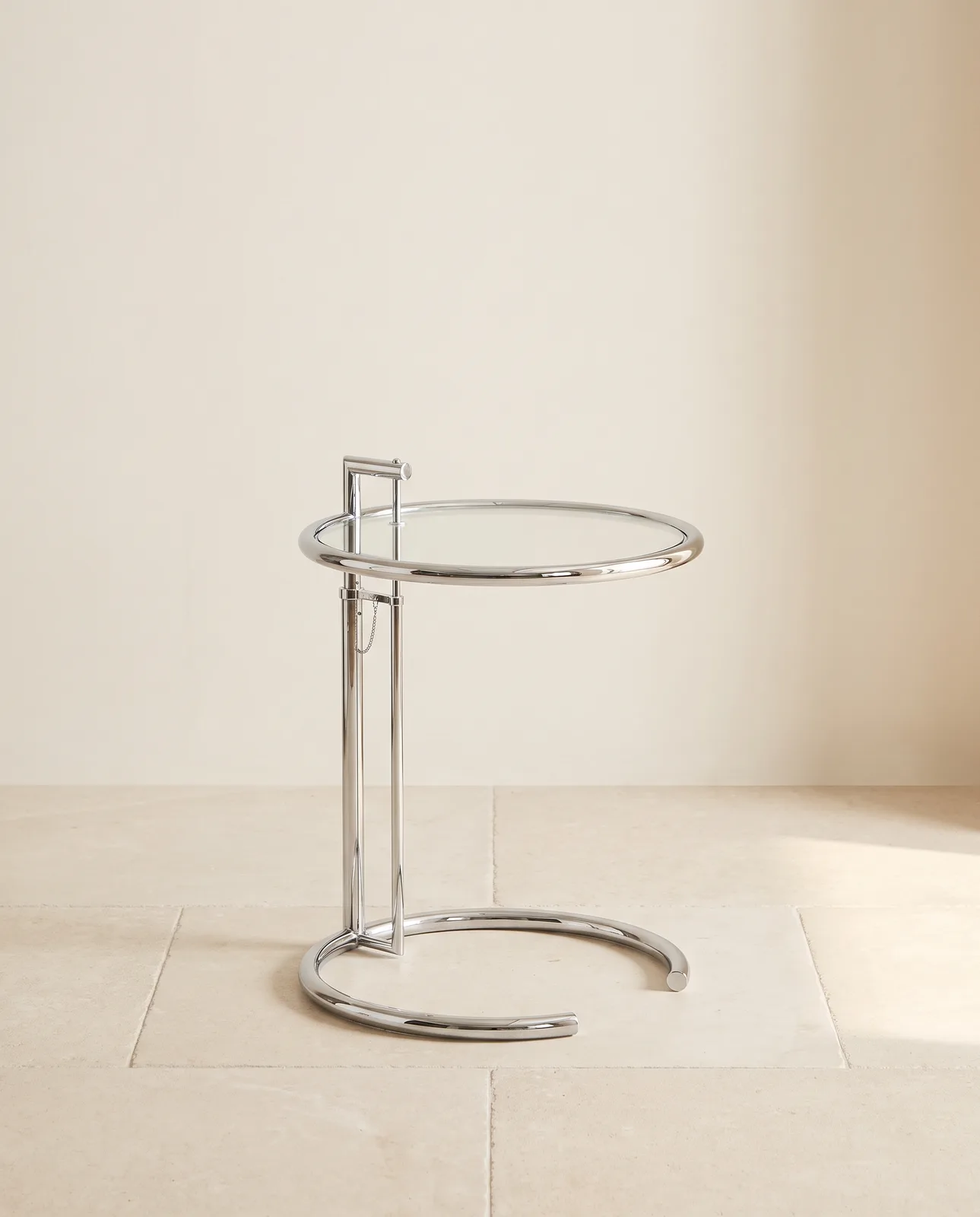
A circle of glass, floating on a bent chrome-tube ring: Eileen Gray's adjustable table was designed in 1927 for a single holiday house on the French Riviera, for a very personal reason — it needed to reach over a bed.

Designed for a house named E.1027

Eileen Gray, an Irish architect and designer, created the table that bears her house's name in 1927 for the Villa E.1027 in Roquebrune-Cap-Martin on the French Riviera, which she built together with her partner Jean Badovici. The house's own name is an encoded declaration of love: E for Eileen, 10 for J (the 10th letter), 2 for B (Badovici), and 7 for G (Gray). The table grew out of a very concrete need: Gray's sister liked to have breakfast in bed, so a table was needed that could slide over the edge of a bed and adjust in height.

A chrome-tube ring as the adjustment mechanism

The construction consists of a circular base and a vertical chrome-tube post encircled by a bent ring — that ring slides along the post and locks at virtually any height with a simple clamp, letting the round glass top be positioned over a bed, chair, or sofa. That solution was, in 1927, both technically elegant and unusually uncomplicated: no lever, no motor, just a precisely made ring sliding on a post.

A marginal figure of early Modernism

Eileen Gray worked in parallel with Le Corbusier and the Bauhaus, but for a long time wasn't admitted into the modernist canon with the same weight — partly because she worked as a woman in a male-dominated architecture scene, partly because she was less commercially visible. Her adjustable table shares chrome tubing and a reduced, functional form language with the Bauhaus movement, but pairs it with a circular form unusually playful for Modernism, rather than right-angled geometry — one reason her work is undergoing a reassessment today.

Function as a design principle

The E1027 table is a textbook example of how a very specific, personal need can produce a universally useful piece of furniture. Its height adjustability still makes it more versatile than most side tables: a breakfast table over the bed, a movable surface beside the sofa, or a low coffee table, depending on the setting. That functionality never reads as visually intrusive — the clean, circular form works as a self-contained sculptural object even without a practical purpose.

The E1027 table in a style mix

The table works beautifully next to other chrome-tube classics like the LC4 or the LC3 sofa, but it also complements softer settings: in a Boho bedroom with rattan and textiles, it supplies a cool, industrial accent; in a Modern Organic room with natural stone and linen, it adds a transparent, light counterpoint; and next to Vintage furniture in dark wood, it creates an appealing material contrast between chrome, glass, and warm wood.

Ateliology Style Verdict

The E1027 table proves that the best design solution can sometimes come from a very personal, small problem rather than a grand conceptual ambition. Eileen Gray's combination of function and circular clarity makes it one of the quietest and, at the same time, most influential style pieces of furniture Modernism.