Back to overview
Noguchi Coffee Table
1944 (American Modern)

Noguchi Coffee Table

Isamu NoguchiHerman Miller, USA

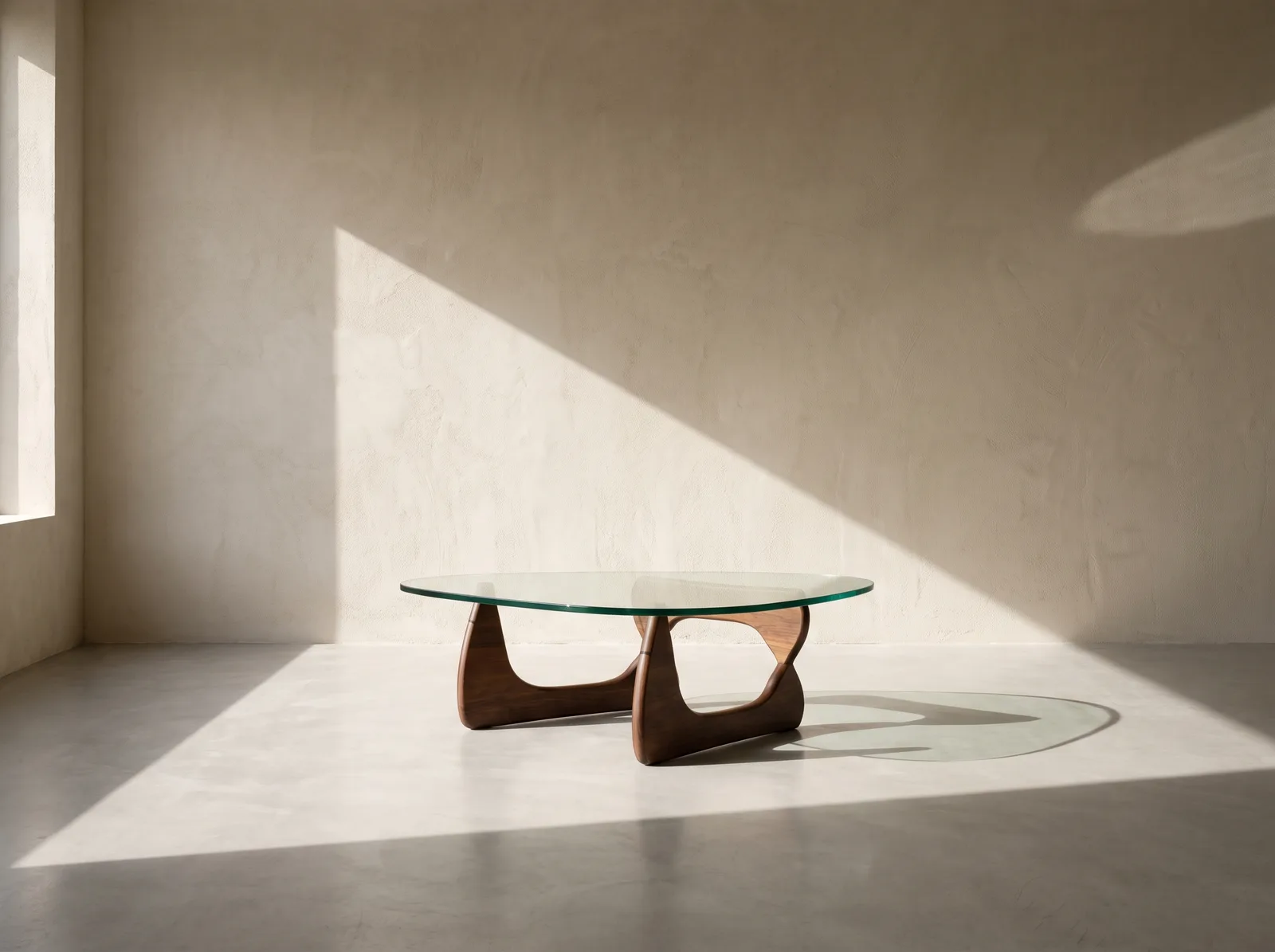
Two interlocking wood elements support a floating, freeform glass top — since 1944, the Noguchi Coffee Table has proven that a table made of just three parts can become one of the most sculptural icons in furniture history.

More Than a Coffee Table

A coffee table is normally a functional side piece, barely worth mentioning. The Noguchi Coffee Table is the exception: a freeform-cut glass top that appears to float weightlessly atop two interlocking, biomorphically curved wood elements. Designed in 1944 by Japanese-American artist and designer Isamu Noguchi, this table is still treated less as furniture and more as a standalone sculpture that happens to also serve as a surface.

A Sculptor Designs Furniture

Noguchi was primarily a sculptor, not a classically trained furniture designer — a fact directly reflected in the form of his best-known table design. The idea originally grew out of a piece Noguchi had created back in 1939 for publisher A. Conger Goodyear. When Herman Miller design director George Nelson discovered the table, he convinced Noguchi to rework the design for wider production, which finally resulted, in 1944, in the version still produced today.

Three Parts, No Tools

Constructively, the Noguchi Coffee Table consists of only three elements: two identically shaped wooden legs that interlock and stand stable purely through their own weight and precise fit, plus a triangular glass top with organically rounded corners that simply rests on top of the wooden base. No tools, no screws, no visible joints are required — the entire structure relies on the precise geometry of the wood form, a feat of engineering that makes the table's sculptural simplicity possible in the first place.

American Modern Meets Biomorphism

The table emerged in the 1940s, a period when American designers were beginning to move away from rigid geometry toward flowing, nature-inspired forms — a trend later termed biomorphism. Noguchi's background as a sculptor, having worked closely with artists like Constantin Brâncuși, made him a natural representative of this movement within furniture design. The glass top's freeform shape deliberately recalls abstract sculptural forms of that era rather than classic table geometry.

From Side Table to Collector's Piece

Herman Miller has produced the Noguchi Coffee Table almost continuously since 1944, and it's now one of the most widely copied pieces of furniture in existence — a fact that led Herman Miller to mark every official piece with Noguchi's branded signature. It sits in the collections of numerous design museums and is regularly cited as one of the most significant examples of American post-war design, where fine art and furniture function merge seamlessly.

A Statement for Mid-Century, Modern Organic, and Japandi

The Noguchi Coffee Table fits into a surprising range of styles precisely because it carries so little visual weight itself. In Mid-Century interiors, it complements walnut furniture and geometric textures as an organic counterpoint. In Modern Organic rooms, its biomorphic form underscores the style's nature-driven material language. And in Japandi interiors, its pared-back three-part construction fits perfectly with that style's appreciation for craft, material, and deliberate restraint.

The Noguchi Coffee Table in Today's Interiors

The table works best when given room to breathe — in front of a sofa in a relatively open living area, rather than crowded between other furniture. Since the glass top becomes practically invisible when viewed from above, the table reads as visually lighter than its actual dimensions suggest, making it an interesting option for smaller living rooms too. A single object or a small vase arrangement on the glass top is usually enough to highlight the sculptural form without overloading it.

Ateliology Style Verdict

The Noguchi Coffee Table proves that a piece of furniture made from just three parts, with no visible joints at all, can become one of the most sculptural icons in design history. Born from a sculptor's hand, it remains, more than 80 years after its introduction, an object that merges art and function so naturally that the line between the two nearly disappears. That is exactly what makes the Noguchi Coffee Table a genuine style piece.