Back to overview
Beat Light
2007 (contemporary Industrial design)

Beat Light

Tom DixonTom Dixon, United Kingdom

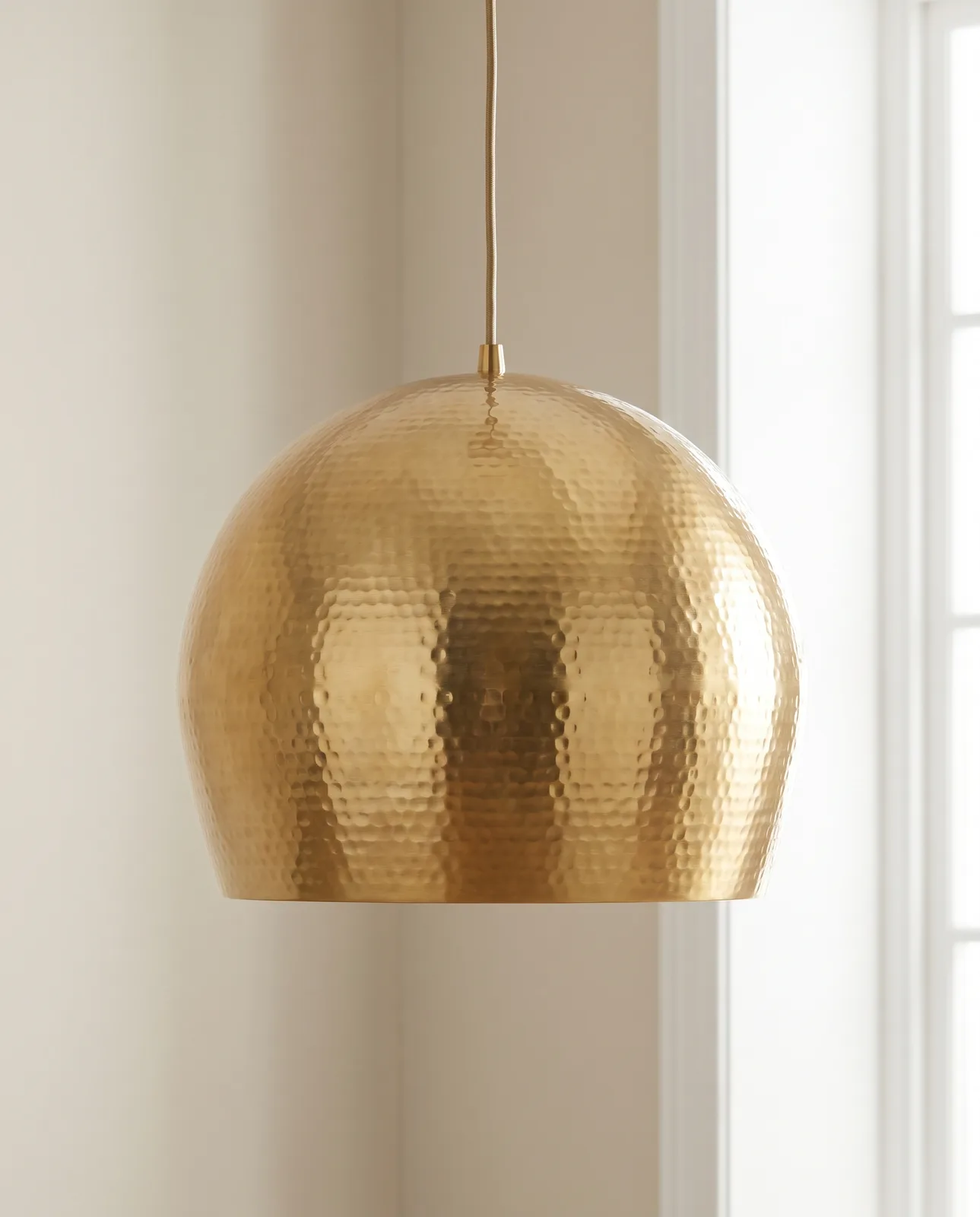
Hand-beaten brass, gleaming gold inside and darkly patinated outside: Tom Dixon's 2007 Beat Light brought an Indian metalworking technique traditionally used for water vessels into Western lighting design — and became the most copied pendant lamp of the early 21st century.

A self-taught designer rooted in craft

Tom Dixon arrived at design by an unusual route: he began his career as a musician and taught himself metalworking after a motorcycle accident ended his music career. That hands-on, undogmatic approach shapes his entire body of work, including the Beat collection introduced in 2007. Rather than inventing a new form, Dixon drew inspiration from traditional Indian water vessels, hand-hammered from brass for generations.

Hand-beaten brass from India

Beat lamps are still handcrafted today by artisans in India using a traditional metal-beating technique, in which a brass disc is hammered repeatedly into a round, bellied form. That process leaves fine, irregular hammer marks on the surface, so every lamp turns out slightly individual. The inside stays highly polished, casting a warm, golden light, while the outside is left darkly patinated or matte — a deliberate contrast between a gleaming interior and a raw outer shell.

Between craft tradition and the global mass market

Stylistically, the Beat Light sits within an early-21st-century movement that paired industrial, often "Industrial"-labeled design with visibly handcrafted production — a reaction against decades of smooth, flawless mass-produced goods. At the same time, the Beat collection is itself a global trade product, carrying a centuries-old Indian craft technique into Western living rooms, restaurants, and hotel lobbies, and becoming, in the process, one of the most widely copied contemporary lighting designs of all.

Three basic forms for different moods of light

The collection includes three basic forms — Wide (broad and bellied), Tall (slim and elongated), and Stout (compact and round) — which are especially effective arranged in clusters of varying heights above a kitchen island or dining table. The lamp's narrow lower opening focuses the light into a warm, sharply defined pool, while the wider upper section produces the characteristic golden reflection inside the room.

The Beat Light in a style mix

Clustered above a kitchen island or bar counter, the Beat Light works beautifully in Industrial spaces with brick and steel, but it also adds a warm, handcrafted counterpoint to cool neon light in a Cyberpunk × Art Deco interior. In a Modern Luxury room with marble and dark surfaces, its warm brass glow provides an inviting accent, and next to Boho natural materials like rattan and linen, the lamp's handmade texture fits in effortlessly.

Ateliology Style Verdict

The Beat Light proves that contemporary design doesn't have to stand in contradiction to centuries-old craft. Tom Dixon's transposition of an Indian metal-beating technique into Western lighting made it one of the most influential and widely copied style pieces of the 2000s.

Related style