Back to overview
Serge Mouille Wall Lamp
1954 (French Modernism)

Serge Mouille Wall Lamp

Serge MouilleEditions Serge Mouille, France

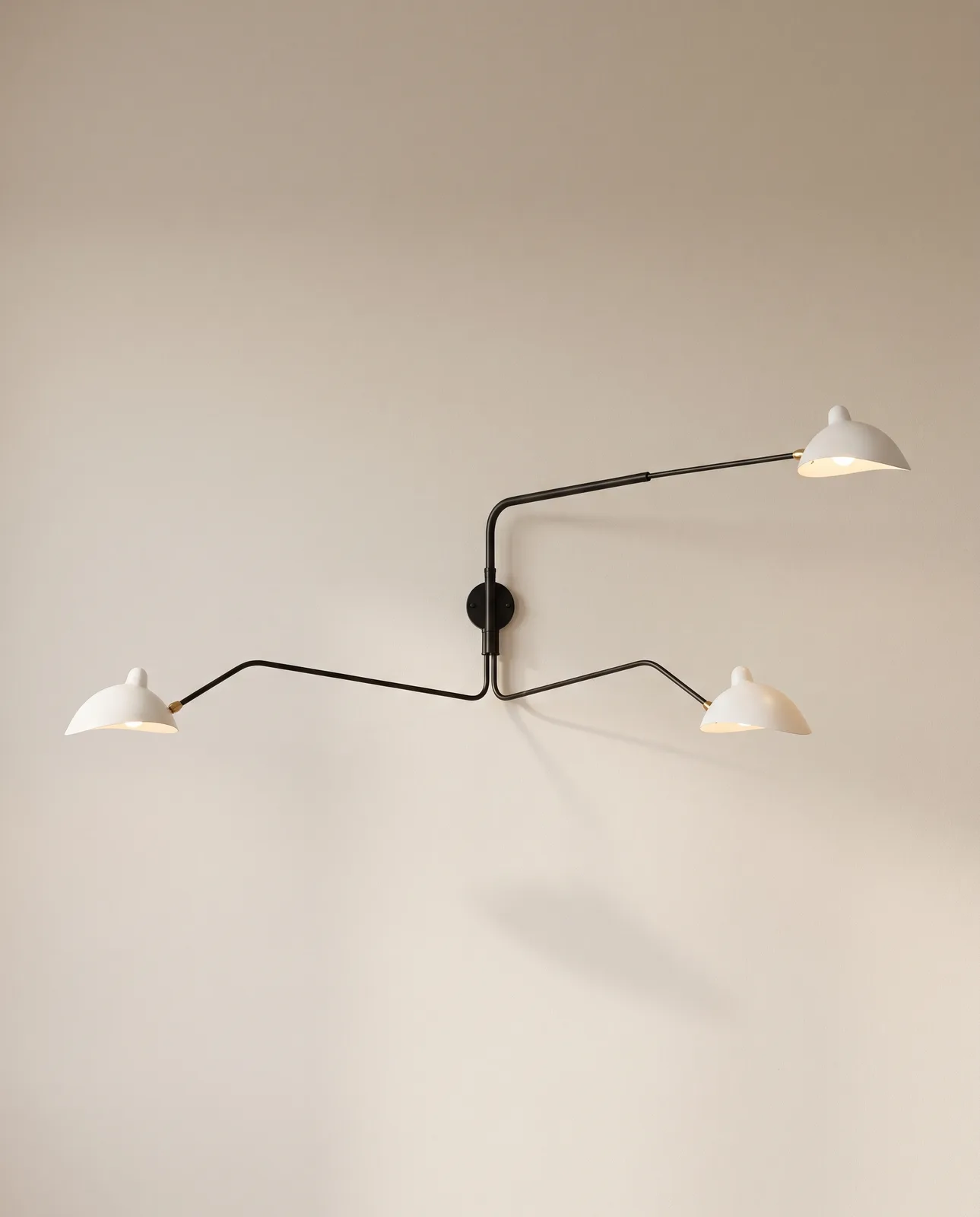
Three black, curved steel arms ending in small, insect-like shades: Serge Mouille's 1954 wall lamp looks like a technical sculpture — and began as a trained silversmith's solution to a lighting problem.

From silversmith to lighting designer

Serge Mouille originally trained as a silversmith at the Ecole des Arts Appliqués in Paris and worked initially not as a furniture designer but as a craftsman of decorative metal objects. Only in 1953, in his early thirties, did he turn to lighting — motivated by the observation that French lighting of the day was shaped either by heavy, historicist forms or by cool Bauhaus severity, with no distinctly French contribution to modern lighting design of its own.

Handcraft metalwork rather than cast production

Mouille's lamps weren't cast but built from hand-bent, black-lacquered steel tubing, with small, hand-hammered metal shades mounted at the ends — a direct continuation of his silversmithing training, scaled up considerably. Each arm is bent individually, so even within the same model line, slight variations occur that keep the lamps from ever looking fully identical despite being produced in series. That depth of craftsmanship clearly sets Mouille's work apart from the industrially stamped lighting series of his contemporaries.

Biomorphic form within French Modernism

Stylistically, Mouille's work belongs to the biomorphic branch of furniture Modernism: the thin black arms with their small, angled shades deliberately evoke insects or plant stems rather than basic geometric forms. That organic form language set him apart clearly from Bauhaus geometric rigor and from contemporary Scandinavian furniture design alike, positioning Mouille as an independent voice within French post-war Modernism, alongside contemporaries like Jean Prouvé, with whom he collaborated at times.

Asymmetry as a deliberate design tool

What's especially characteristic of the three-arm wall lamp is its deliberate asymmetry: the three arms run in different directions and extend different distances from the central wall mount, rather than sitting in mirrored symmetry. That produces a dynamic, almost lifelike overall composition that reassembles itself completely depending on viewing angle — a deliberate break from Modernism's usual preference for strict symmetry.

The Serge Mouille lamp in a style mix

As a purely sculptural object, the lamp works in almost any context that calls for a graphic, drawing-like gesture: on a pale limewash wall in a Modern Organic room, it reads like a three-dimensional sketch; in an Industrial loft with raw metal and brick, it fits in with material honesty; and next to ornamental Louis XVI furniture, an appealing contrast emerges between organic reduction and courtly decoration. In a Brutalist bathroom of exposed concrete, too, it adds a delicate, almost linear counterpoint to the raw materiality.

Ateliology Style Verdict

The Serge Mouille wall lamp proves that craft skill from an entirely different trade — silversmithing — can lead to one of furniture history's most distinctive lighting forms. Its deliberate asymmetry and graphic presence make it a style piece that transforms any room like a drawing on the wall.