Back to overview
Panton Chair
1967 (Space Age / Pop Art)

Panton Chair

Verner PantonVitra, Switzerland

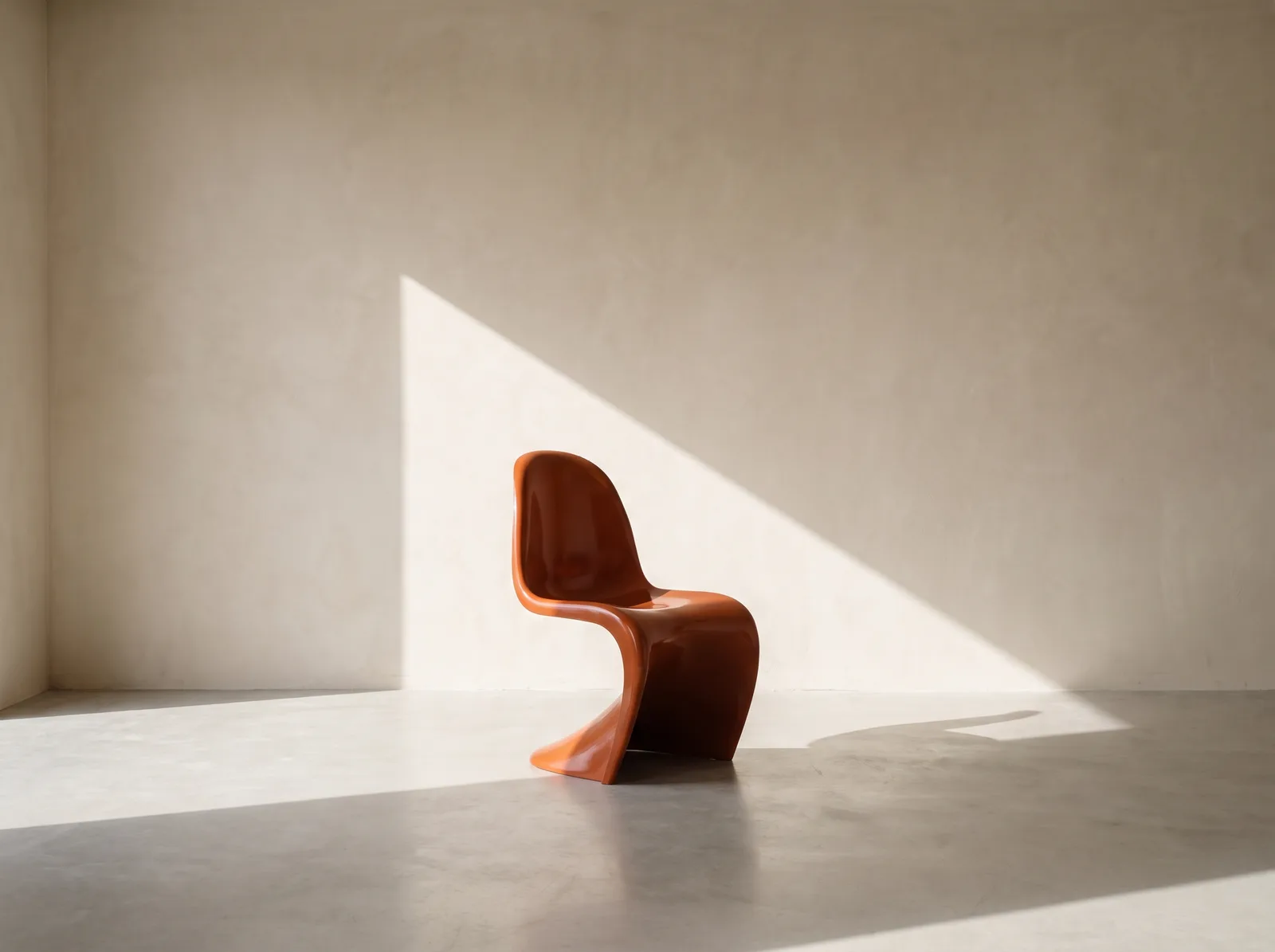
A single, sweeping piece of plastic with no legs in the traditional sense — in 1967, the Panton Chair became the first chair ever molded from a single piece of material, and it remains one of the boldest statements in furniture history.

More Than a Chair — a Silhouette

Some pieces of furniture need no explanation to be instantly recognizable. The Panton Chair is one of them: a single, flowing S-curve of glossy plastic, with no visible legs, no seams, no transitions. When Verner Panton introduced this design in 1967, nothing comparable existed — not in its form, and not in how it was made. Nearly sixty years later, the Panton Chair remains one of the boldest and most photographed statements in furniture history.

The First Chair Molded From a Single Piece

What made the Panton Chair constructively revolutionary wasn't just its shape but how it was made: it was the first chair in the world produced entirely from a single piece of injection-molded plastic — no frame, no joints, no separate legs. Panton had been pursuing this idea since the early 1950s, but the available material technology initially couldn't keep pace with his vision. It took a collaboration with Swiss furniture manufacturer Vitra and the chemical company BASF to find a material stable, elastic, and moldable enough to support the seat's dramatic cantilevered overhang.

A Stackable Chair With Ambition

Despite its sculptural appearance, the Panton Chair was conceived from the start as a practical, stackable piece of seating — a deliberate response to post-war demand for affordable, mass-producible furniture. Its one-piece plastic body was easy to clean, more weather-resistant than wood or upholstery, and allowed several chairs to be stacked space-efficiently on top of one another. That combination of radical form and practical function was unusual for the 1960s, making the chair equally attractive for private homes and public or commercial spaces.

Space Age and the Pop Art Era

The Panton Chair emerged right at the cultural peak of the Space Age — a period when the moon landing, futuristic materials research, and a broad enthusiasm for plastics and new technology also shaped furniture design. At the same time, its bold, saturated color palette of red, orange, and white fits seamlessly into the Pop Art movement of those years. Verner Panton himself was known for his experimental use of color and light, and the Panton Chair condenses that sensibility into a single, unmistakable object.

From Bestseller to Museum Piece

After its market launch, the Panton Chair quickly became a commercial success and was produced in the millions. It now sits in the permanent collections of the Museum of Modern Art in New York and the Vitra Design Museum, and is considered one of the most significant examples of the fusion between industrial manufacturing technique and artistic form in the 20th century. Over the decades, production has been refined several times to improve stability and environmental impact, while the original silhouette has remained unchanged.

A Statement for Space Age and Pop Art

The Panton Chair isn't a chair you place in a room casually — it demands attention, and that's exactly where it works best. In Space Age interiors with organic forms and futuristic materials, it fits in as a logical addition. In Pop Art-driven rooms with bold blocks of color and graphic patterns, it acts as a sculptural, three-dimensional counterpoint to flat color fields. In both cases, a single Panton Chair is usually enough to set the stylistic tone for an entire room.

The Panton Chair in Today's Interiors

The Panton Chair usually has the most impact as a standalone piece — at a desk, in a reading nook, or as an eye-catcher beside a more restrained sofa. A row of several chairs in different colors can create a deliberately playful, graphic effect in a dining area. Those who prefer to tone down the contrast can opt for more neutral finishes in white or black, which emphasize the sculptural form without dominating the room's color scheme.

Ateliology Style Verdict

The Panton Chair proved that a chair could be completely rethought — not just in its form, but in how it's made in the first place. Years of material research produced an object that still feels like a vision of the future, despite being nearly sixty years old. That rare combination of technical innovation and timeless visual force is exactly what makes the Panton Chair a genuine style piece.