Back to overview
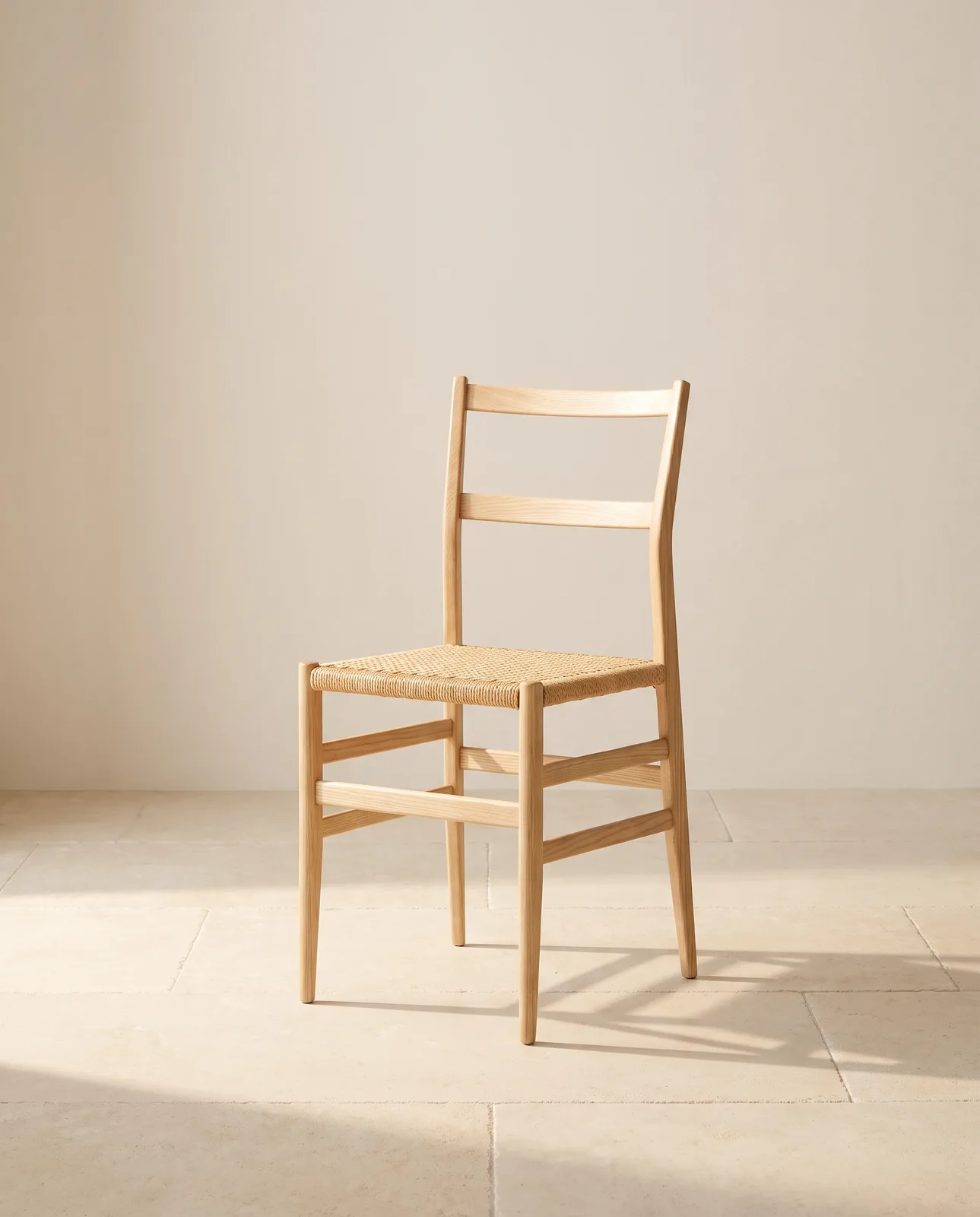
Superleggera Chair
1957 (Italian Mid-Century Modern)
Superleggera Chair

Gio PontiCassina, Italy

A pale ash-wood chair so light a child can lift it with one finger: in 1957, Gio Ponti distilled a traditional Ligurian fisherman's chair down to its absolute essence — and created a symbol of Italian lightness in the process.

From a Chiavari fishing chair to a design icon

The Superleggera's starting point wasn't a drafting table but a regional craft object: the traditional "Chiavarina" chair from the Ligurian coastal town of Chiavari, a simple, sturdy wooden chair local craftsmen had made for fishing and farming households since the early 19th century. Gio Ponti — architect, designer, and co-founder of the magazine "Domus" — saw enormous potential for reduction in that rustic form. Starting in the early 1950s, he worked with manufacturer Cassina to pare the traditional Chiavari construction down as far as technically possible without losing structural stability. The result launched in 1957 under the programmatic name "Superleggera" — "super light."

A chair light enough to lift with one finger

The result weighs only about 1.7 kilograms — a fraction of what a classic wood chair of comparable size normally weighs. That was achieved through the consistent tapering of every component: the legs have a triangular rather than round cross-section, preserving maximum stability with minimal material, while the seat and back are made from woven cane or thin wood slats. Cassina's famous advertising photo of a child lifting the chair with a single finger wasn't an exaggeration — it was a literal demonstration of the engineering feat.

Italian rationalism rather than Scandinavian warmth

Stylistically, the Superleggera belongs to post-war Italian Mid-Century Modern — a design tradition distinct from the concurrent Scandinavian furniture movement. Where Scandinavian design often leaned on warm, visible wood and organic curves, Ponti pursued a more rationalist, almost engineering-driven approach: form here strictly follows the question of how little material a given function actually requires. The pale, often untreated ash tone stays deliberately restrained — the chair is meant to impress through its construction, not its surface.

Why less furniture creates more effect here

Precisely because the Superleggera feels so light and delicate, it often makes the strongest impression in smaller numbers rather than as a full matching set: a single chair at a solid wood table or beside a console highlights the contrast between lightness and mass especially clearly. Gathered in larger numbers around a dining table, on the other hand, it creates an almost weightless, transparent effect in the room, since its thin legs barely block the sightline — an effect much heavier chair designs simply can't achieve.

The Superleggera in a style mix

The Superleggera works beautifully as a quiet counterpoint to opulent or heavy styles: next to a raw-concrete Brutalist room, its lightness reads as almost weightless; in a Modern Luxury dining room with marble and brass, it keeps the ensemble from feeling too heavy; and even beside ornamental Louis XVI furniture it creates an interesting dialogue between two entirely different ideas of elegance. In Japanese-inspired Japandi rooms, it adds a distinctly Italian note to that same restraint.

Ateliology Style Verdict

The Superleggera proves that radical reduction need not feel cold: from a simple fishing chair, Gio Ponti distilled one of design history's most technically demanding and, at the same time, most restrained pieces of furniture. It's exactly that combination of lightness and precision that makes it a timeless style piece.