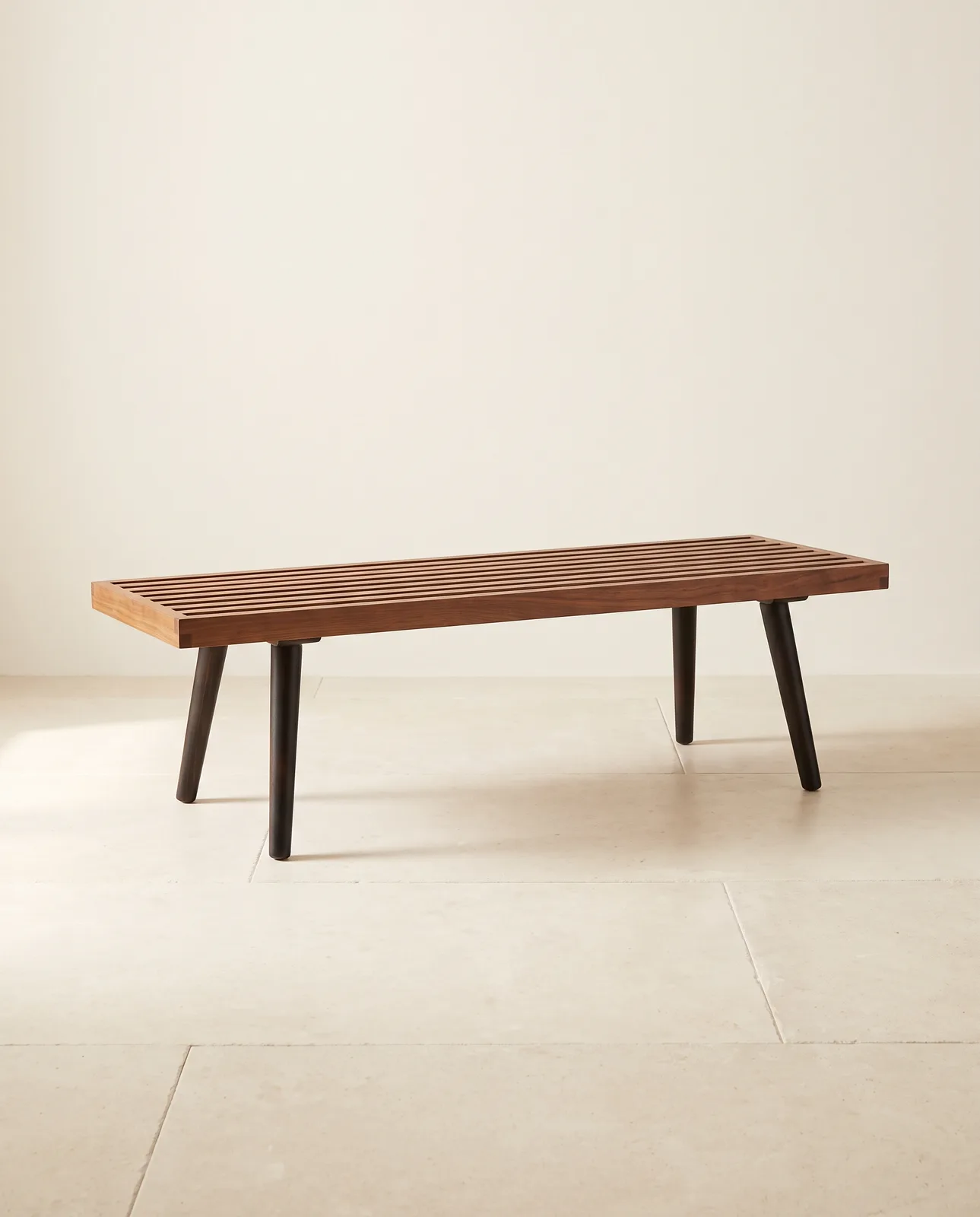
Nelson Platform Bench
George Nelson — Herman Miller, USA
A simple wood slab on angled dowel legs: George Nelson's 1946 Platform Bench was originally conceived as an accessory to his shelving system — and ended up becoming one of the most versatile pieces of American post-war Modernism.
From shelving accessory to standalone classic
George Nelson, Herman Miller's design director from 1945 onward, originally designed the Platform Bench in 1946 as a practical companion to his "Basic Storage Components" shelving system — meant as a flexible surface or seat within modular storage walls. It quickly became clear, though, that the bench worked perfectly well entirely independent of any shelving system, and it grew into a standalone success that remains in production today.
Construction reduced to the essentials
The construction consists of a single rectangular solid-wood slab, usually walnut or maple, resting on four turned dowel legs splayed outward at an angle — no aprons, no stretchers, no visible joinery. That extreme reduction to slab and leg makes the bench one of the structurally simplest pieces in Mid-Century Modern furniture, without ever feeling unstable: the angled leg placement provides plenty of stability on its own, with no additional components needed.
A piece of furniture with no fixed function
What sets the Platform Bench apart from most furniture classics is its deliberate functional openness: it was never conceived strictly as a bench, a coffee table, or a shelf, but as a neutral, horizontal plane whose use shifts with context. At the foot of a bed, it serves as a surface for laying out clothes; in the living room, as a low coffee table; in a hallway, as a spot to sit and put on shoes. That versatility was an unusually modern furniture concept for the 1940s.
Why walnut remains the most common choice
Nelson favored warm, medium-brown woods like walnut or cherry, which balance the construction's strict minimalism with a homely, natural note. That material choice makes the bench more compatible with warm living spaces than many other Mid-Century objects made of steel or plastic — one reason it still slots effortlessly into rooms with a wide range of wood tones today, without ever dominating stylistically.
The Platform Bench in a style mix
The bench works almost anywhere a calm, horizontal surface is needed: at the foot of a bed in a Japandi bedroom, as a coffee-table alternative in a Boho living room with rattan and textiles, or as a seat in a hallway with an Art Deco tiled floor. Next to louder styles like Memphis or Pop Art, it stays deliberately understated, letting the room's bolder elements take the lead without ever feeling like filler.
Ateliology Style Verdict
The Platform Bench proves that a side product can sometimes become the real classic. George Nelson's reduction to slab and leg remains one of the most versatile and unobtrusive style pieces of American furniture Modernism.