Eames RAR Rocking Chair
Charles & Ray Eames — Vitra, Switzerland / Herman Miller, USA
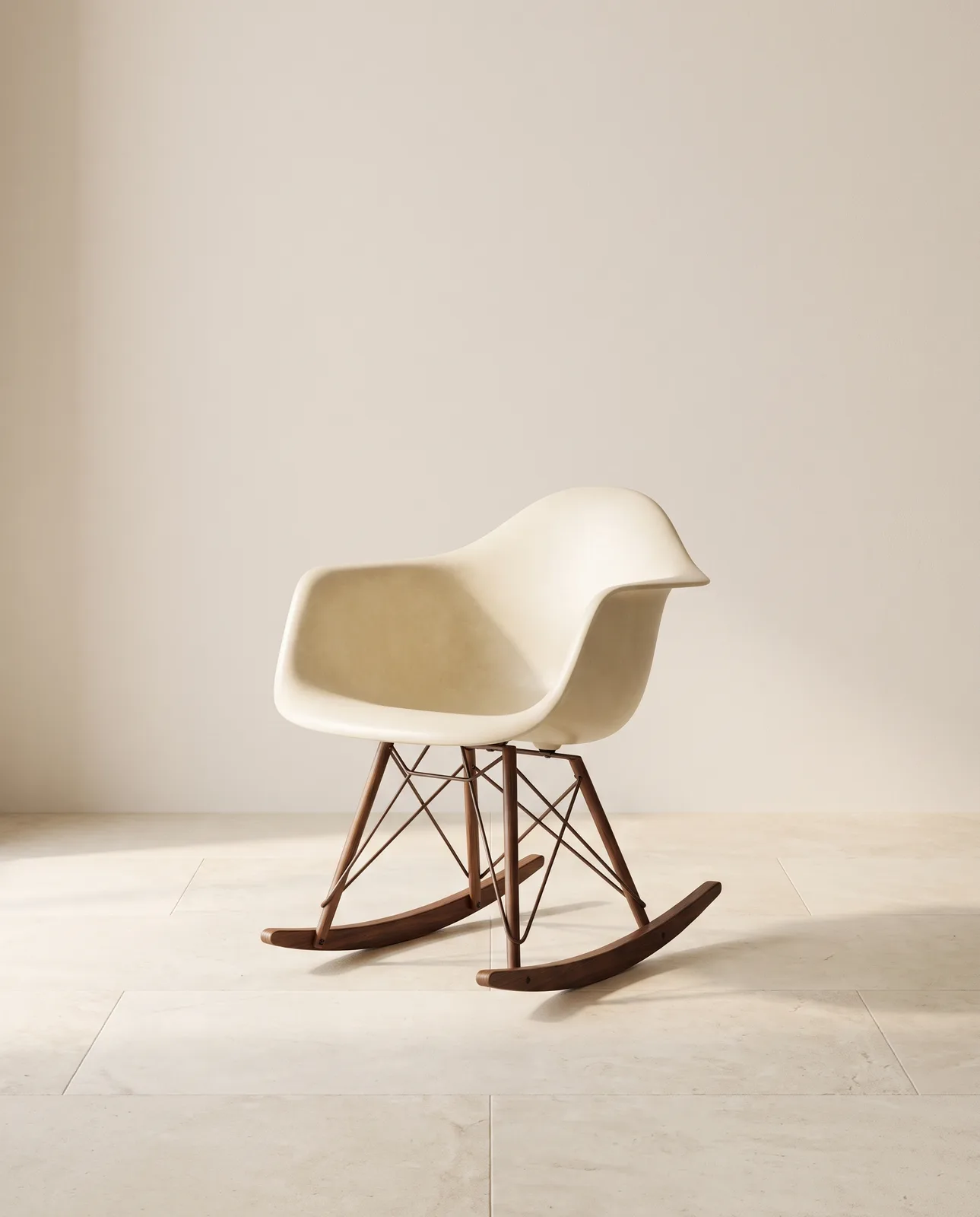
A molded plastic shell in a warm parchment tone, mounted on a rocker base of wood and steel rod: the Eames RAR was one of the first mass-produced plastic chairs ever made, turning a materials experiment into one of the 20th century's most approachable design icons.
Born from a competition for affordable design
The RAR's story doesn't begin with the rocker base but with the seat shell itself. Charles and Ray Eames developed it for the Museum of Modern Art's "International Competition for Low-Cost Furniture Design" in 1948, a competition explicitly seeking well-designed but mass-affordable seating for the post-war era. The original idea of stamping the shell from metal failed for manufacturing reasons. Only the collaboration with boat- and aircraft-parts maker Zenith Plastics made production possible around 1950, using fiberglass-reinforced polyester plastic — a material previously used mainly in military and boatbuilding.
From shell experiment to rocking chair
From the start, the fiberglass shell was conceived as a modular system: the same form could be mounted on different bases — metal legs, wood legs, a swivel base, or a rocker base made from bent solid wood with a stabilizing steel-rod substructure (rocker plus rod base, hence the model name RAR). The combination of a shell that felt futuristic for its time and a warm wooden rocking base still makes the RAR one of the most unusual pieces in the Eames collection: technically advanced and gently soothing in motion at once.
Organic Design and the limits of mass production
Stylistically, the RAR belongs to the Organic Design movement, which traded geometric rigor for softer forms derived from the human body — a direct continuation of ideas Eero Saarinen and Charles Eames had already pursued in their 1940 "Organic Design in Home Furnishings" competition entries. At the same time, the RAR is a child of mass production: only the ability to manufacture complexly shaped shells at scale and with consistent quality made this organic form language affordable for a broad audience. The chair marks a turning point where design quality was no longer necessarily tied to one-off craftsmanship.
Parchment, Elephant Hide Grey, and the early colorways
The early production years offered only a few deliberately restrained colorways, like the warm off-white "Parchment" or the cooler "Elephant Hide Grey," both chosen to emphasize the material itself rather than an applied color. Only later runs expanded the palette to bolder hues. For a style-fusion interior, that's an advantage: in one of the original natural tones, the RAR fits in almost anywhere without competing with other color accents in the room, while its rocking motion gives it an informal, inviting character many other design classics simply don't offer.
The RAR in a style mix
The RAR works beautifully as a soft counterpoint in rooms with a cooler form language: next to Space Age objects in chrome or glass, its organic shell feels pleasantly grounding; in a Boho living room with rattan and macramé, it adds a sculptural note to the natural materials; and in a Vintage interior with walnut furniture, its wood base fits right in. It's especially compelling paired with graphic Pop Art: the chair's calm, organic form makes bold, comic-style wall art read even stronger by contrast.
Ateliology Style Verdict
The RAR proves that design history isn't always written in the luxury segment — its origins lie in a competition for affordable living. That accessibility, combined with a shell that was materially revolutionary for its time, makes it one of the warmest and most significant style pieces of the Mid-Century Modern era.