Back to overview
Cesca Chair
1928 (Bauhaus)

Cesca Chair

Marcel BreuerKnoll, USA (licensed production)

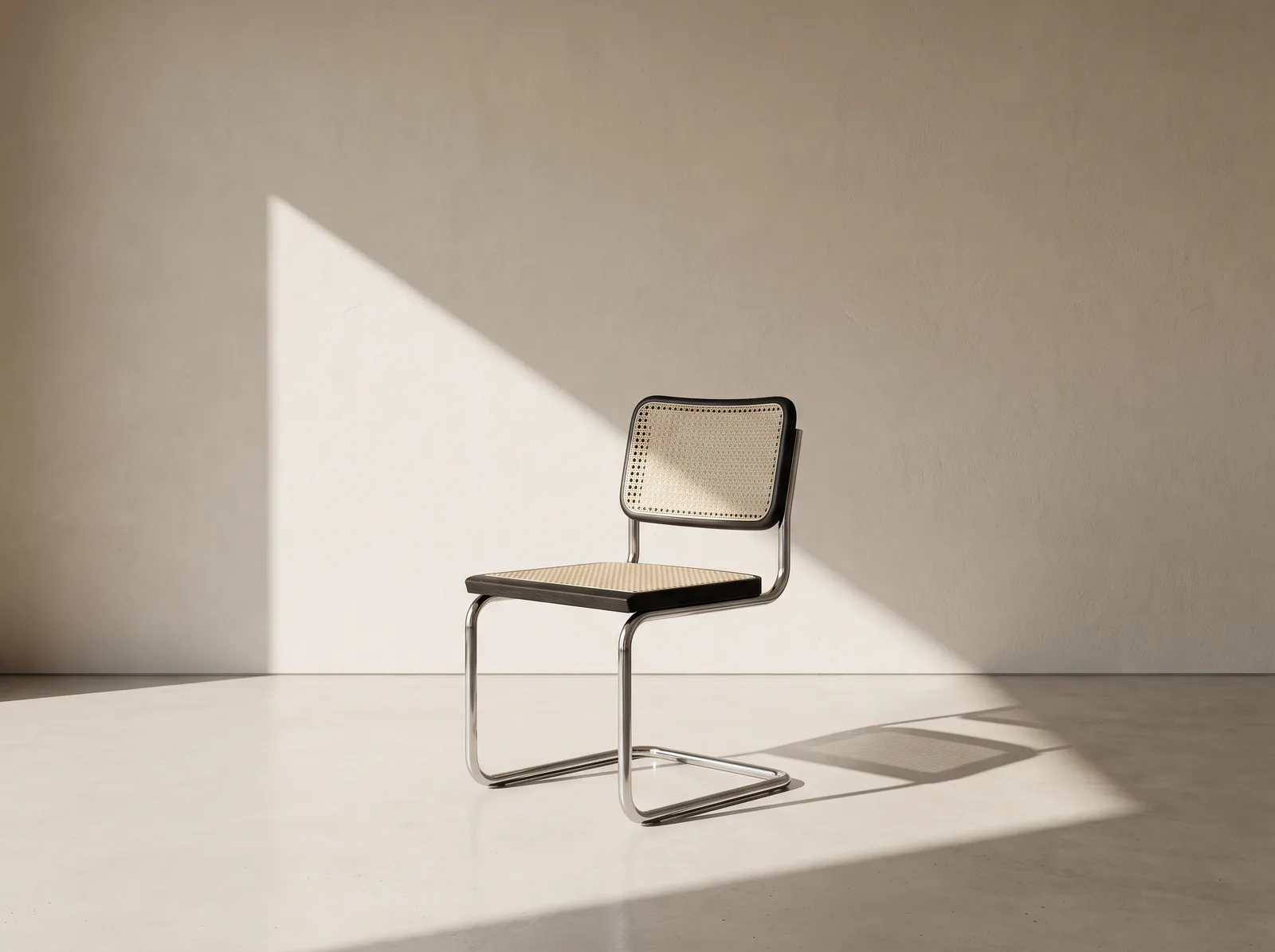
A cantilevered tubular steel frame meets hand-woven cane and warm wood — as early as 1928, the Cesca Chair combined industrial construction with traditional craft, and remains one of the most copied chairs of modernism today.

More Than a Cantilever Chair

The Cesca Chair is among the earliest and most influential cantilever chairs in furniture history — chairs with no back legs at all, relying instead on the springiness of a bent tubular steel frame. That construction gives the chair a distinctive, gentle flex when you sit down, one that many reproductions still fail to convincingly replicate.

From Bicycle to Cantilever

Marcel Breuer, who had already designed the first tubular steel chair with the Wassily Chair in 1925, further developed the cantilever principle in 1928 alongside Dutch architect Mart Stam, who had built an early but rigid cantilever prototype. Breuer recognized that the springy behavior of tubular steel could be used for added comfort rather than treated as a pure engineering problem — a crucial refinement that led to one of the defining chair concepts of the 20th century.

Craft Meets Industry

What makes the Cesca Chair distinctive is its deliberate material contrast: the cool, glossy tubular steel frame meets hand-woven Viennese cane for the seat and backrest. That combination of industrial precision and traditional craftsmanship was unusual for the Bauhaus era, since many contemporaries saw tubular steel as the opposite of handmade production. Breuer proved otherwise.

From "Model B32" to "Cesca"

The chair originally carried the technical designation "Model B32." It only received its now-familiar name "Cesca" when Knoll reissued the design in the 1960s — named after Breuer's adopted daughter, Francesca. That personal namesake stands in contrast to the strictly industrial, almost anonymous form language of the chair, and shows how design icons often only receive their well-known identity after the fact.

A Bauhaus Classic in the Museum

The Cesca Chair is part of the permanent collection at the Museum of Modern Art in New York and is considered one of the most significant examples of Bauhaus furniture design philosophy: function, material, and construction should visibly depend on one another rather than hide behind decoration. Since Knoll's reissue, the chair has been produced continuously and remains one of the best-selling design classics in existence.

A Statement for Mid-Century and Industrial

The Cesca Chair works convincingly in Mid-Century interiors, where the warm cane sets an inviting tone next to walnut furniture, as well as in Industrial rooms, where the tubular steel frame picks up on the raw materiality of exposed concrete and metal. That dual suitability makes it one of the most versatile design classics for different room concepts.

The Cesca Chair in Today's Interiors

The Cesca Chair shows its full effect at the dining table, especially when several chairs together emphasize the repeating cane texture. As a single piece at a desk, it feels pared-back and light without losing character. Since cane is more delicate than full upholstery, it's better suited to dry indoor spaces than heavily used outdoor areas.

Ateliology Style Verdict

The Cesca Chair proved that tubular steel and craft don't have to be opposites — they can reinforce each other. Nearly a hundred years after its creation, it remains a statement that industrial construction and traditional craftsmanship can form a coherent whole together. That is exactly what makes the Cesca Chair a genuine style piece.